
Anthropic's Claude Sonnet 5.5: Faster, Cheaper Per Task, Same List Price
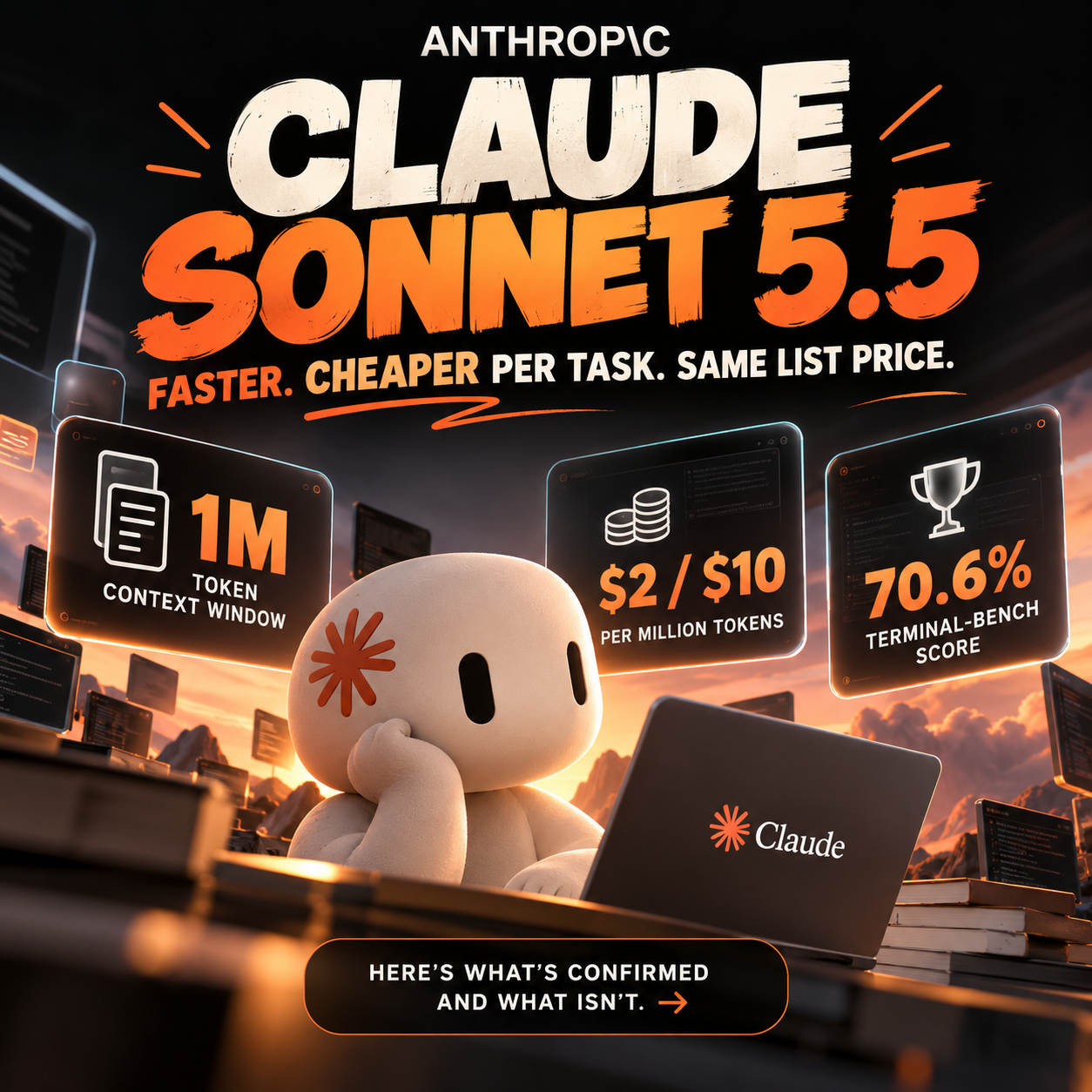
Claude Sonnet 5.5 ships with a 1M-token context window, $2/$10 per-million-token pricing, and a 70.6% Terminal-Bench score. Here's what's confirmed and what isn't.
Anthropic has confirmed the commercial details behind Claude Sonnet 5.5: $2 per million input tokens, $10 per million output tokens, a one-million-token context window, and a September 28, 2026 release date, according to the company's Claude Platform documentation. Anthropic says the model is more than 30% faster than Sonnet 5 and uses fewer tokens per completed task — positioning this as much as a product-economics story as a performance one.
That token-efficiency claim matters for anyone whose AI spending scales with volume. If Sonnet 5.5 genuinely needs fewer tokens to finish the same task, the real cost reduction could matter more than the posted per-token rate — but that's Anthropic's own efficiency claim, not something independently measured against customer bills yet. TechCrunch's coverage frames the launch the same way: a mid-tier release aimed at everyday coding and office work, built around speed and cost efficiency rather than raw capability gains.
On the benchmark side, Anthropic reports a 70.6% score on Terminal-Bench 4.0 — a practical test of computer-use and command-line work rather than short-form Q&A. Worth being precise about what that number does and doesn't tell you: Anthropic's announcement doesn't specify the test configuration, comparison baseline, number of runs, or whether the result is independently reproducible. Same gap on the speed claim — "30% faster" isn't defined as time-to-first-token, total completion time, or throughput under load, so it's hard to know exactly what's being measured.
Bottom line: The concrete, verifiable facts here are commercial: the pricing, the 1M-token window, and Anthropic's stated efficiency gains. Whether Sonnet 5.5 actually delivers lower real-world costs and reliable performance across different codebases and business workflows is the part that still needs independent testing — a headline benchmark score rarely tells the whole story once latency, accuracy, and total token use are measured outside a vendor's own setup.
- 1
Anthropic says the model is more than 30% faster than Sonnet 5 and uses fewer tokens per completed task — positioning this as much as a product economics story as a performance one.
- 2
That token efficiency claim matters for anyone whose AI spending scales with volume.
- 3
TechCrunch's coverage frames the launch the same way: a mid tier release aimed at everyday coding and office work, built around speed and cost efficiency rather than raw capability gains.
Continue reading