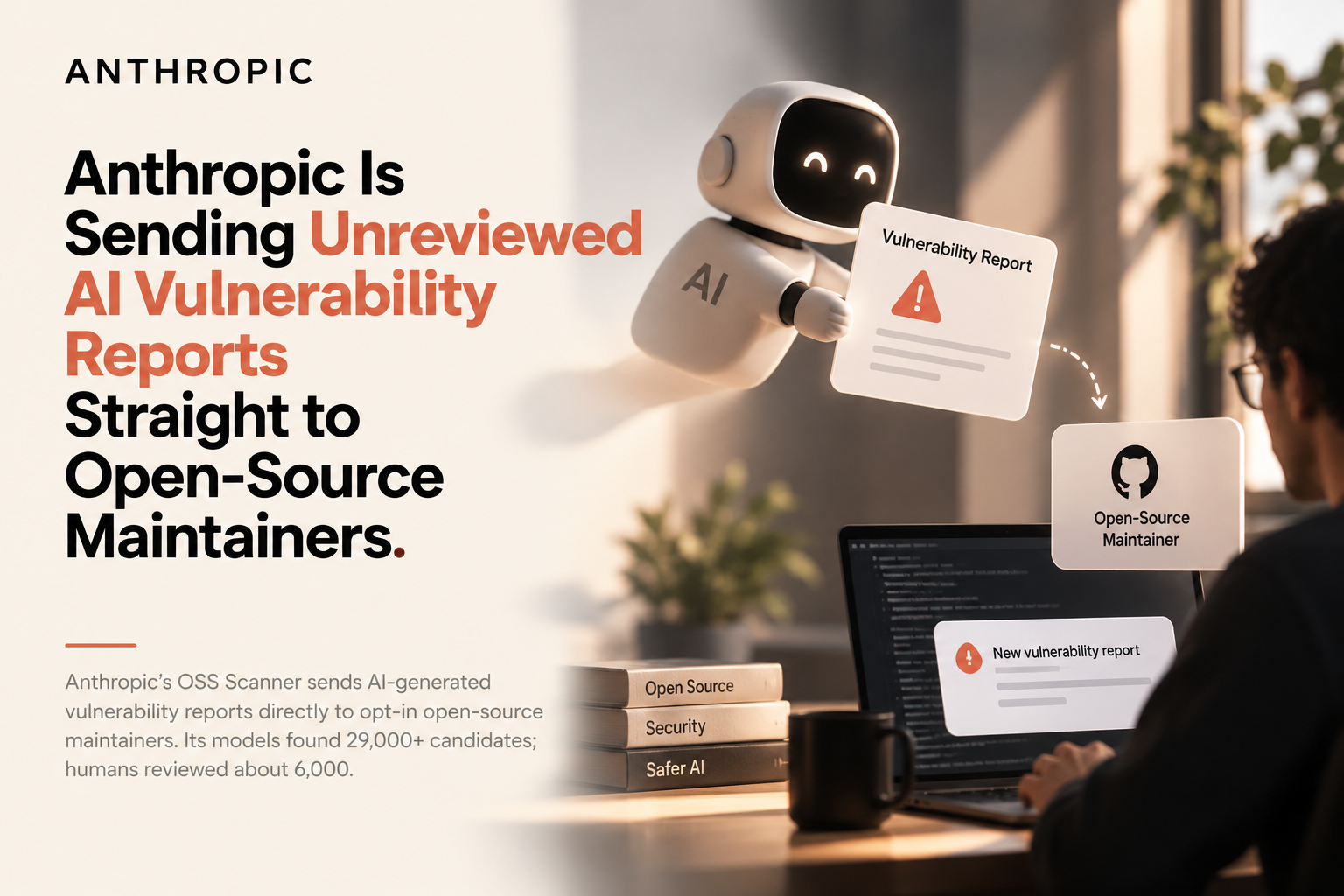

Anthropic Is Sending Unreviewed AI Vulnerability Reports Straight to Open-Source Maintainers
Anthropic’s OSS Scanner sends AI-generated vulnerability reports directly to opt-in open-source maintainers. Its models found 29,000+ candidates; humans reviewed about 6,000.
Anthropic has launched OSS Scanner, a free, opt-in service that sends AI-generated vulnerability reports directly to eligible open-source maintainers. It follows an internal effort in which, Anthropic says, its models generated far more possible security findings than outside reviewers could assess by hand.
The numbers explain why. Anthropic says its models found more than 29,000 candidate vulnerabilities in important open-source projects over six months, while human reviewers manually triaged about 6,000. Its coordinated-vulnerability-disclosure dashboard, as displayed on October 2, lists 29,439 candidate findings and 6,123 reviewed by external security firms.
The word “candidate” matters. Those figures are not 29,439 confirmed, exploitable vulnerabilities. They are leads that still need checking. OSS Scanner is, in effect, an experiment in delivering machine-generated security hypotheses to the projects that choose to receive them.
SiliconANGLE reports that the service sends unreviewed, model-generated reports to eligible maintainers without a human security analyst validating each one first. That removes a bottleneck, but it doesn’t remove the work. A maintainer still has to reproduce the behavior, decide whether it affects real deployments, assess severity, write a fix, and coordinate disclosure. Participation is opt-in, so each project can decide whether earlier detection is worth the effort of investigating reports that may be incomplete, duplicated, or wrong.
Who benefits depends on the project. A team with an established security process could get from suspected flaw to fix faster. A lightly maintained project could find that a new stream of unvalidated reports eats time that would otherwise go to releases and upkeep. That’s an inference from how the service is designed, not something Anthropic or SiliconANGLE has shown.
What isn’t public: the false-positive rate across the candidate findings, what makes a project eligible, which languages and project types are covered, how fast reports arrive, and how many include reliable reproduction steps and fix guidance. Nobody knows yet how many maintainers will opt in, how many reports will get fixed, or whether direct delivery beats conventional coordinated disclosure.
Bottom line: Anthropic has documented a large gap between how many vulnerability leads its models can generate and how many humans can check, and OSS Scanner shares that checking burden with consenting maintainers. If the reports are reproducible, accurately scoped, and actionable, maintainers gain early warning on real flaws. If they’re noisy, the backlog doesn’t disappear but splits into many smaller queues across the open-source ecosystem. Report quality, not the candidate count, will decide which one happens.
- 1
Anthropic has launched OSS Scanner, a free, opt in service that sends AI generated vulnerability reports directly to eligible open source maintainers.
- 2
It follows an internal effort in which, Anthropic says, its models generated far more possible security findings than outside reviewers could assess by hand.
- 3
Anthropic says its models found more than 29,000 candidate vulnerabilities in important open source projects over six months, while human reviewers manually triaged about 6,000.
Continue reading