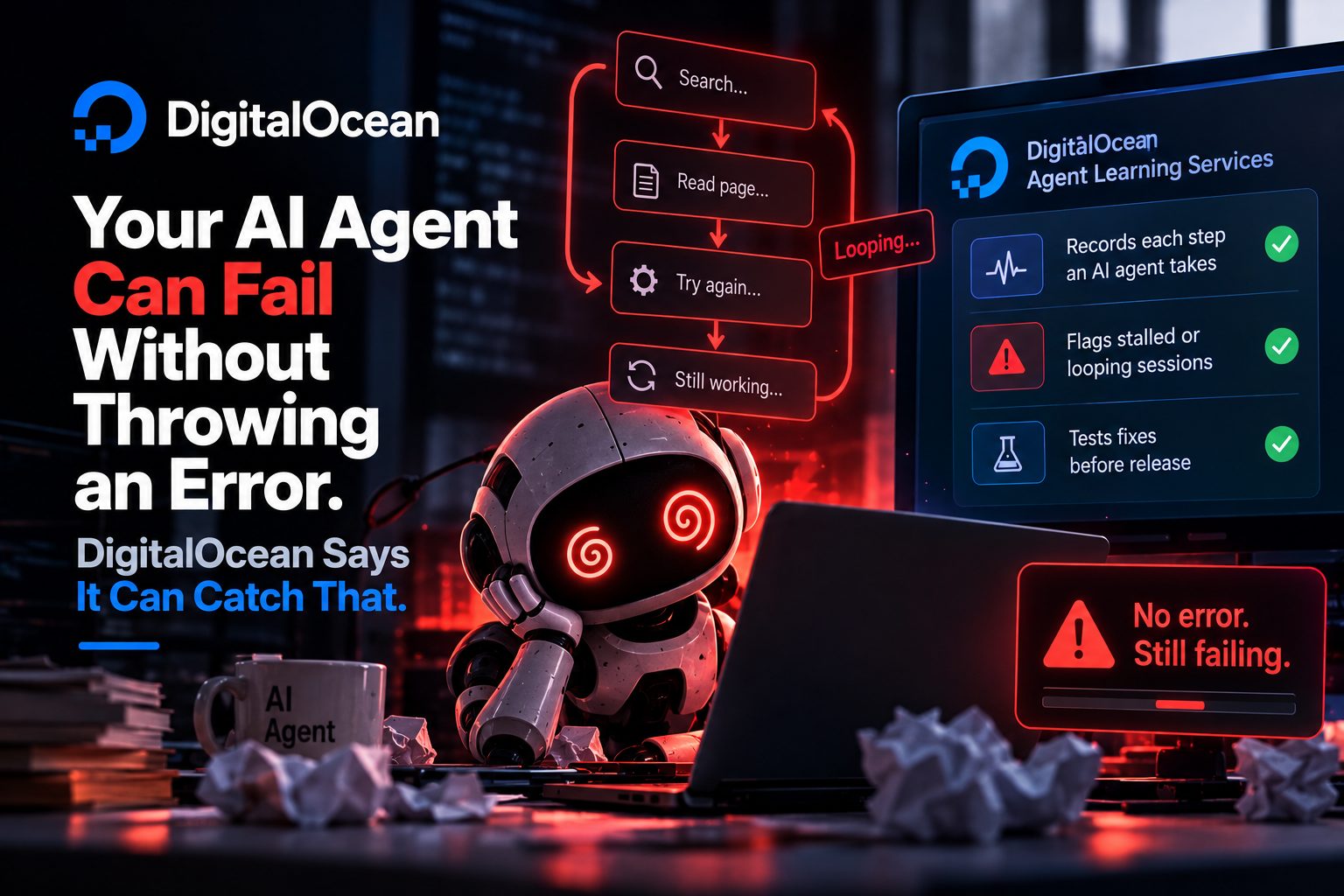

Your AI Agent Can Fail Without Throwing an Error. DigitalOcean Says It Can Catch That.
DigitalOcean’s Agent Learning Services record each step an AI agent takes, flag stalled or looping sessions, and test fixes before release. Here’s what’s claimed and what isn’t proven.
DigitalOcean has announced Agent Learning Services, a set of tools it says will capture an AI agent’s actions during a session, flag problem interactions, and test proposed changes before they’re deployed. It’s part of a broader Agent Learning and Data Services offering, announced through Business Wire.
The most concrete promise isn’t that agents will improve themselves. It’s a better record of what happened when an interaction went wrong. According to the announcement, the services log each step an agent takes and identify sessions where it stalled, got stuck in a loop, lost the user, or never completed the interaction. StreetInsider’s republication of the wire announcement describes the same capabilities.
That targets a real gap. An agent can call its tools, return a response, and trigger no ordinary infrastructure error, while still failing to get the user to a finished outcome. Standard monitoring won’t flag that as a problem. DigitalOcean’s pitch is to keep enough behavioral detail that a developer can trace the path that led to the failure.
The offering includes Insights, Evaluations, and Simulations. In principle, that gives teams a regression-testing path for agent behavior: find a session that failed, change an instruction or workflow, then check the revised agent against realistic conversations before shipping it. That’s the workflow DigitalOcean describes, though the announcement doesn’t specify the data model, retention behavior, or supported integrations.
What isn’t shown: how the “realistic conversations” are created, whether they come from production records, how sensitive data is handled, or how closely simulations match live traffic. The announcement also publishes no measurements of failure-detection accuracy, simulation fidelity, or reliability gains from customers. It’s a company announcement, so everything about performance is DigitalOcean’s own description.
“Self-improving” is a framing to test. DigitalOcean calls the release infrastructure for “recursively self-improving” agents, but the described features are observability, evaluation, and pre-release testing for the people building agents. Nothing in the announcement shows agents choosing their own changes, applying them, or deploying themselves, or that using the services raises an agent’s production success rate.
Bottom line: Agents that fail without alerting anyone are a real operational problem, and keeping a step-by-step trail plus a way to test fixes before release is a sensible answer to it. Whether it makes agents more dependable depends on things the announcement doesn’t yet supply: customer results, simulation quality, and technical detail. For teams building agents, the questions to ask are how faithful the simulations are and what the session records actually capture.
- 1
DigitalOcean has announced Agent Learning Services, a set of tools it says will capture an AI agent’s actions during a session, flag problem interactions, and test proposed changes before they’re deployed.
- 2
It’s part of a broader Agent Learning and Data Services offering, announced through Business Wire.
- 3
The most concrete promise isn’t that agents will improve themselves.
Continue reading