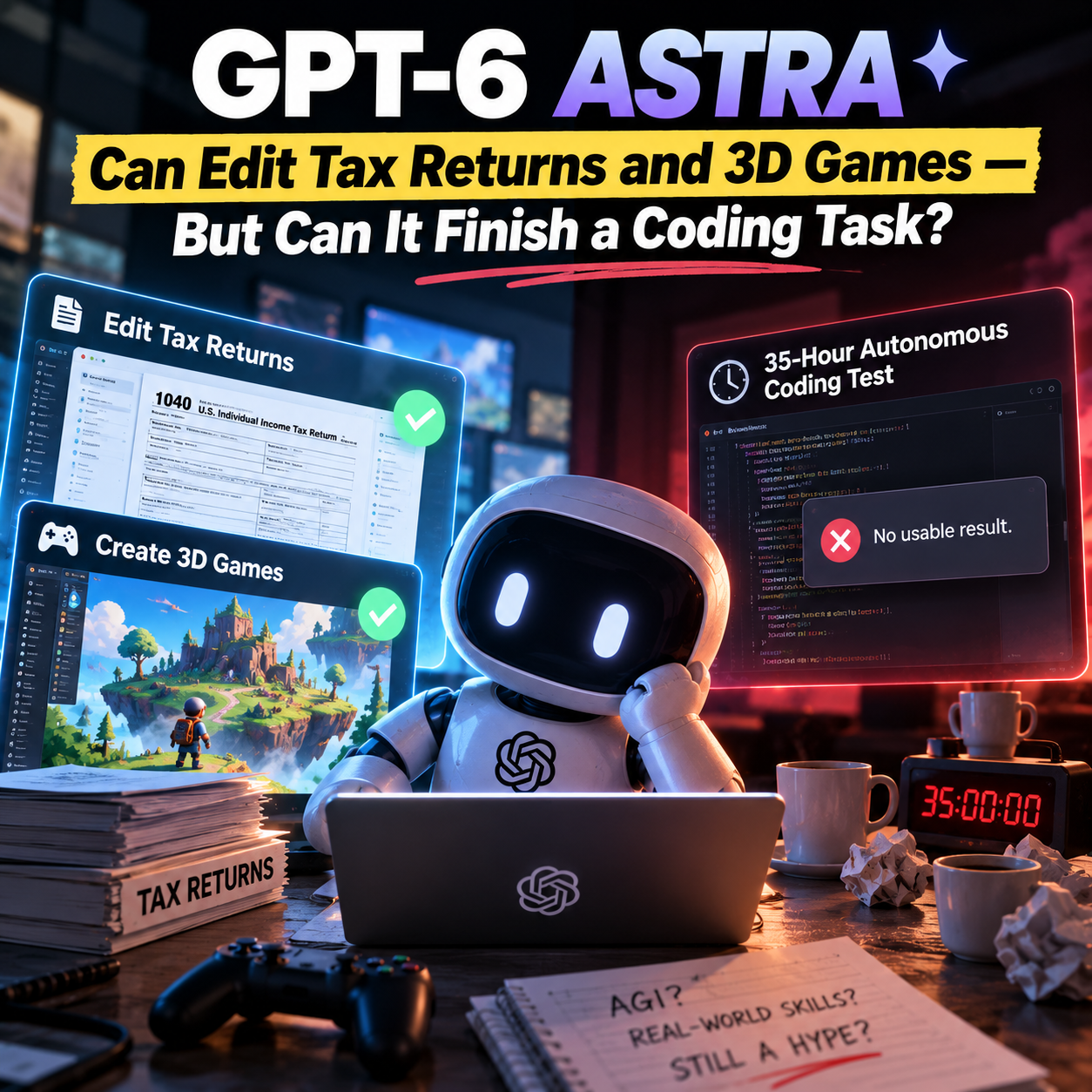

GPT-6 Astra Can Edit Tax Returns and 3D Games — But Can It Finish a Coding Task?
OpenAI positions GPT-6 Astra as AGI-capable computer-use software. An early 35-hour autonomous coding test produced no usable result. Here's what's confirmed.
OpenAI has introduced GPT-6 Astra as a model meant to operate across workplace software — not just answer questions, but actually work inside the tools professionals already use. It's rolling out in stages to Plus, Pro, Business, and Enterprise users through ChatGPT Work and Codex. The launch framing is unusually ambitious: Axios reported demonstrations spanning legal-document formatting, tax-return drafting, circuit-board layout, a 3D game, and work inside Blender — and reported that OpenAI said Astra may represent artificial general intelligence.
That's a massive claim, and it's worth being precise about what backs it up: nothing public does, yet. There's no definition, benchmark result, or independent evaluation attached to the AGI framing — just a set of demonstrations. Demonstrations can show range. They can't show reliability, and reliability is the part that actually matters once a model is making changes inside real files and production tools rather than just generating text. Axios itself flagged open deployment and cybersecurity-safety questions around the launch.
Here's where the gap becomes concrete. Developer Armin Ronacher reported that Astra was genuinely impressive on long-running and visual tasks — but a 35-hour autonomous coding experiment produced no useful result, and the code it did generate was hard to maintain. That's a meaningful data point, because finishing a coding task isn't the same as producing code that exists. A usable result has to fit the project, actually solve the problem, stay understandable to the people who maintain it, and not create more cleanup work than it saves.
To be fair to Astra: one developer's 35-hour run isn't a controlled study across repositories, prompts, or configurations, and it doesn't prove Astra fails at autonomous coding broadly. But it does show that a long autonomous session can burn significant time without producing anything a team would actually want to ship — even from the same developer who found real promise in the model's visual and extended-task abilities.
Bottom line: OpenAI has shown Astra doing genuinely ambitious things across very different software environments, and an early account suggests real capability in long-running and visual workflows. What's still unanswered is whether it can deliver dependable, maintainable software reliably enough to trust with real professional engineering work — and OpenAI's own demonstrations aren't evidence of that until independent reliability testing catches up.
- 1
OpenAI has introduced GPT 6 Astra as a model meant to operate across workplace software — not just answer questions, but actually work inside the tools professionals already use.
- 2
It's rolling out in stages to Plus, Pro, Business, and Enterprise users through ChatGPT Work and Codex.
- 3
That's a massive claim, and it's worth being precise about what backs it up: nothing public does, yet.
Continue reading