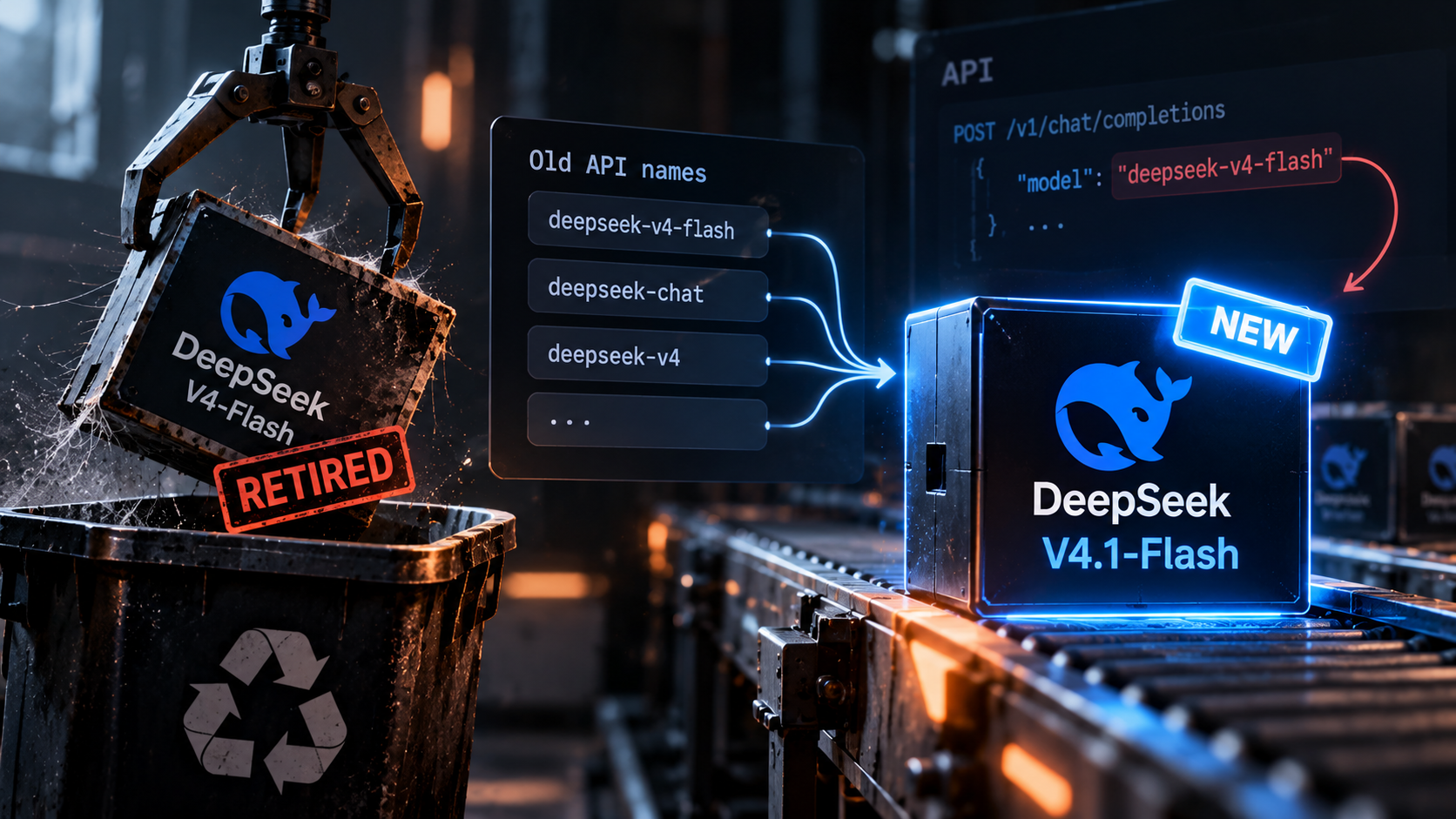

DeepSeek Retired V4-Flash. Old API Names Now Hit a Different, Larger Model.
DeepSeek retired V4-Flash and now routes legacy API names to V4.1-Flash, a different model. Here’s why that can break benchmarks and comparisons, and what to record.
DeepSeek has retired V4-Flash and says its legacy API names now temporarily route requests to DeepSeek-V4.1-Flash. For developers, that means a call through an older V4-Flash identifier may no longer test the model originally announced under that name.
The two models are described very differently. In its April V4 preview, DeepSeek presented V4-Flash as an open-weight mixture-of-experts model with 284 billion total parameters and 13 billion active, a one-million-token context window, reasoning modes, and API availability. Hugging Face described the checkpoint the same way and characterized its benchmark results as competitive, not state of the art.
DeepSeek’s follow-up announcement describes V4.1-Flash as a multimodal MoE model with 552 billion parameters, activating 8 billion for input processing and 16 billion for output. Those figures can’t be compared directly with V4-Flash’s single 13-billion-active number, and nothing published offers a like-for-like benchmark, latency, hardware, or cost comparison between the two.
The one-million-token headline was also reported by the Associated Press, via Tech Xplore, which said DeepSeek introduced V4 Pro and Flash previews with stronger knowledge, reasoning, and agentic capabilities. But a stated context limit doesn’t show how reliably a model uses information across that window. The available sources don’t include retrieval results on long prompts, task-completion rates, tool-use reliability, security findings, or the cost of processing a full million-token request.
What isn’t clear: DeepSeek calls the routing temporary but doesn’t say how long it will last or whether users can pin requests to the retired V4-Flash checkpoint. It also doesn’t say whether output formats or tool-use behavior differ between the old and new targets.
What this means for anyone testing DeepSeek: a benchmark run last month and one run today under the same name may be measuring different models. If the API response reports which model served the request, log it. If it doesn’t, log the date and the identifier you used, so results can be traced to the right version.
Bottom line: The confirmed change is a product transition. The model behind that identifier may now be V4.1-Flash, not the retired V4-Flash release. Whether that helps or hurts a given workload isn’t established yet, but it does mean any comparison, reproduction, or cost estimate built on the old name needs to be checked before it’s trusted.
- 1
DeepSeek has retired V4 Flash and says its legacy API names now temporarily route requests to DeepSeek V4.1 Flash.
- 2
For developers, that means a call through an older V4 Flash identifier may no longer test the model originally announced under that name.
- 3
Hugging Face described the checkpoint the same way and characterized its benchmark results as competitive, not state of the art.
Continue reading