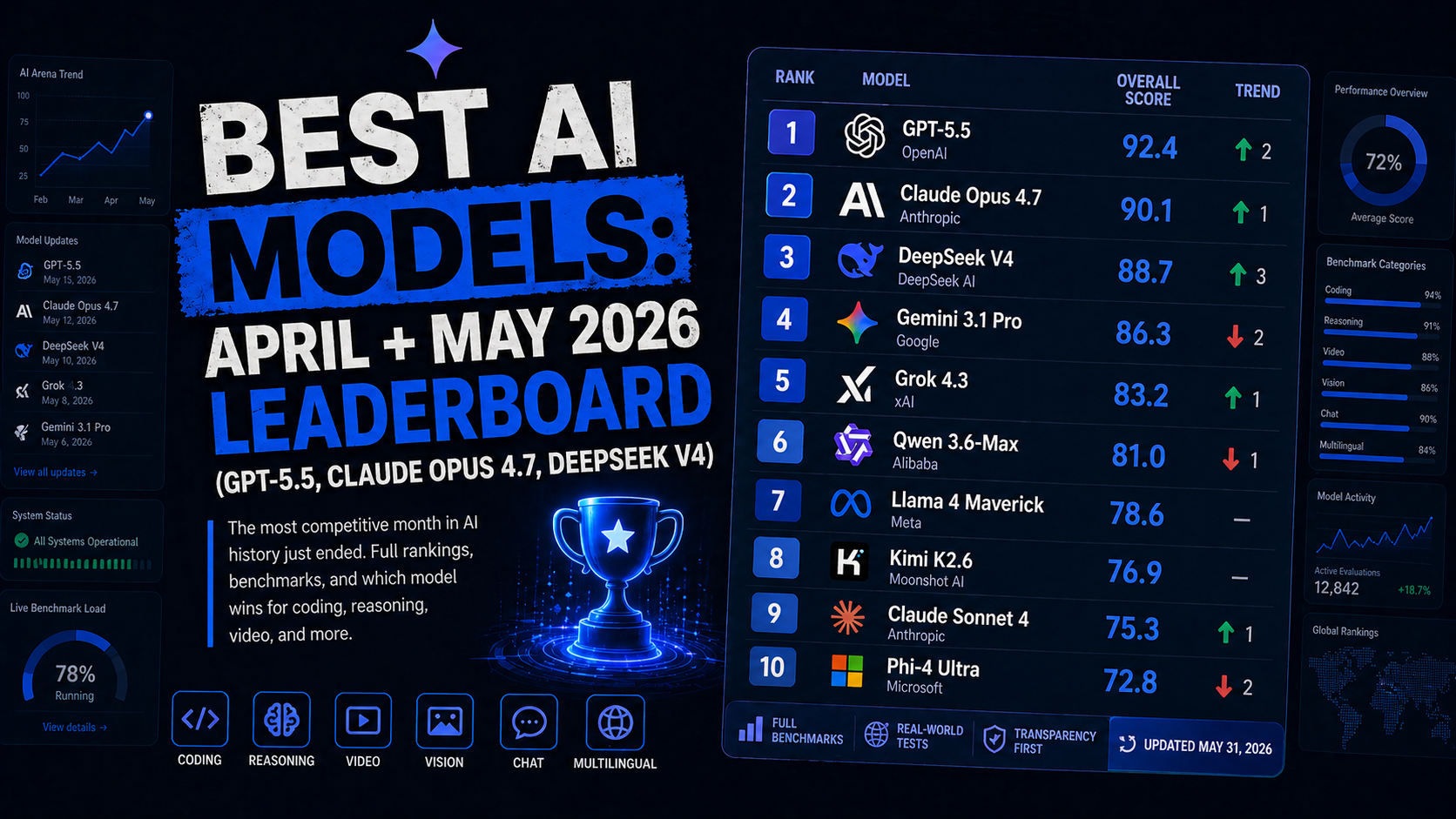

LM Market Cap Updates AI Benchmarks 2026 Catalog Covering 158 Models
LM Market Cap says its AI Benchmarks 2026 catalog, updated June 8, compares 158 AI models across 21 benchmarks and adds practical comparison fields such as pricing, capabilities and context window. The catalog sits alongside more formal benchmarking efforts such as MLCommons’ MLPerf Inference v6.0, which documents s...
LM Market Cap updated its AI Benchmarks 2026 catalog on June 8, presenting a comparison of 158 AI models across 21 benchmarks.
A catalog for comparing many models
According to LM Market Cap’s AI Benchmarks 2026 page, the catalog combines benchmark results with practical model information, including capabilities, pricing, context window and other attributes. The page describes a broad comparison view rather than a single standardized test.
That distinction matters because AI model selection increasingly involves more than leaderboard scores. Teams comparing large language models or multimodal systems may need to consider cost, supported features, context length and deployment fit alongside performance on public benchmarks.
LM Market Cap’s headline figures — 158 models and 21 benchmarks — make the page a wide-ranging model comparison resource. However, the source excerpt does not describe the full methodology behind how the catalog selects, normalizes or presents benchmark inputs. Readers should therefore treat the page as an aggregator-style comparison and review the underlying benchmark and pricing assumptions before making procurement or deployment decisions.
MLPerf offers a standards-based reference point
The update also comes in a period of continued work on formal AI benchmarking. MLCommons, the nonprofit organization behind MLPerf, announced MLPerf Inference v6.0 on April 1, 2026. In its announcement, MLCommons described the release as a major update to its inference benchmark results.
MLCommons said MLPerf Inference v6.0 includes new and updated tests for datacenter and edge environments. The organization also said the suite covers LLM, VLM, recommender and text-to-video benchmark tests. That scope reflects how inference benchmarking has expanded beyond older computer vision and classification workloads into generative AI and multimodal systems.
MLCommons’ documentation for the MLPerf Inference Benchmark Suite lists MLPerf Inference v6.0 along with benchmark models, datasets, frameworks and submission details for the 2026 round. Those materials provide a more formal reference point for readers who want defined workloads and documented submission rules.
Why the comparison is useful, but not definitive
LM Market Cap’s catalog and MLCommons’ MLPerf Inference materials answer different questions. A catalog such as AI Benchmarks 2026 can help users quickly scan many available models and compare practical factors such as price, context window and capabilities. A benchmark suite such as MLPerf Inference v6.0 is designed to provide more structured measurement conditions, with documented workloads and submission requirements.
Neither approach replaces task-specific evaluation. A model that appears strong in a broad comparison may not meet a company’s latency target, cost limit, data handling requirements or domain-specific accuracy needs. Similarly, a strong result in a standardized inference benchmark may not capture product-level factors such as API pricing, tool support, context limits or multimodal availability.
For buyers and developers, the most reliable approach is to use public benchmark resources as a starting point, then run tests on representative workloads. Public catalogs can narrow the field, while formal benchmark suites can provide a disciplined performance reference. Final selection still depends on the application, infrastructure and operating constraints.
What to watch
For LM Market Cap’s AI Benchmarks 2026 catalog, the key questions are methodological: how benchmark inputs are selected, whether scores are normalized, how pricing data is kept current and how fields such as context window or model capabilities are verified.
For MLCommons, the important reference remains the MLPerf Inference v6.0 documentation and result materials, which describe the benchmark models, datasets, frameworks and submission process. Together, the sources show an AI evaluation landscape that is becoming broader and more complex, combining standardized performance tests with deployment-focused information such as cost, context size and supported modalities.
- 1
LM Market Cap updated its AI Benchmarks 2026 catalog on June 8, presenting a comparison of 158 AI models across 21 benchmarks.
- 2
The page describes a broad comparison view rather than a single standardized test.
- 3
That distinction matters because AI model selection increasingly involves more than leaderboard scores.
Continue reading