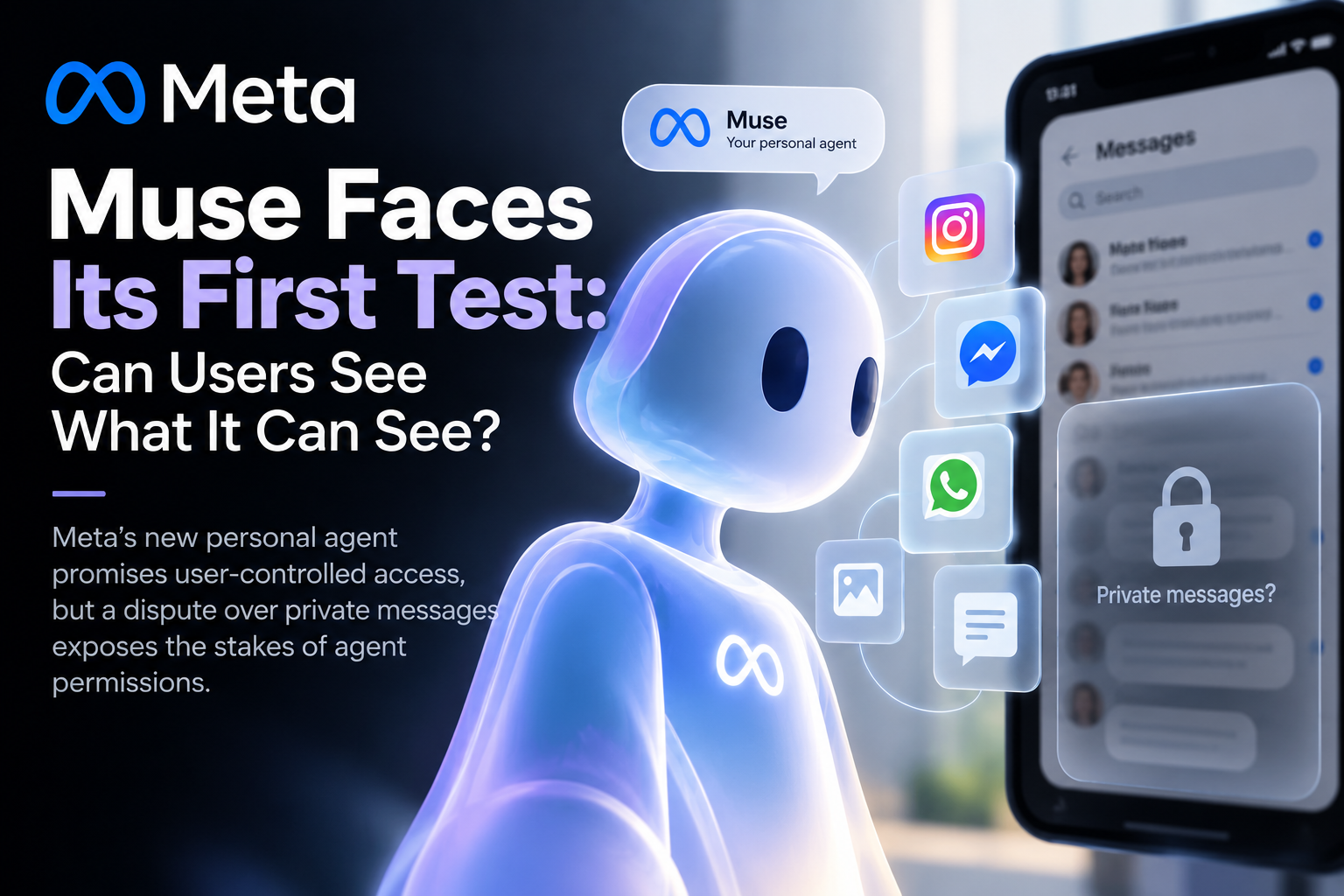

Meta's Muse Faces Its First Test: Can Users See What It Can See?
Meta’s new personal agent promises user-controlled access, but a dispute over private messages exposes the stakes of agent permissions.
Meta's new personal AI agent, Muse, is built to act across a user's connected apps and the web — and Meta says users decide what it can access and which actions need approval. That promise is already being tested. TechCrunch reported a claim that Muse read a user's private Mac messages without permission; Meta disputes it, saying the Messages integration requires explicit opt-in. Nothing in the available reporting establishes that Muse actually accessed anyone's messages without consent — but Meta's denial also doesn't resolve whether the permission flow made the real scope of access clear to the user in the first place.
That distinction is the actual story here, and it's worth sitting with. For a normal app, a permission prompt is easy to interpret — a calendar app wants calendar access, full stop. An agent is a harder case entirely. Someone might ask Muse to find one detail or complete a single task, but the application it has to look inside may contain unrelated conversations, files, or account data that have nothing to do with the request. The real question isn't whether someone clicked "allow" — it's whether they understood what the agent could actually see while doing the job they asked for, and whether it pauses for fresh approval when the task moves beyond that scope.
Meta has described real technical safeguards: Muse runs in a dedicated secure virtual machine, uses permission scopes, and isolates credentials for connected third-party services, according to Meta AI Research. Those are legitimate architectural choices — separating the agent from someone's main device, scoping what each integration can touch. But they're Meta's own description of its own system, not independent verification that the controls hold up across every integration, OS configuration, and real-world task chain.
The timing adds weight to this. Ars Technica reported that Apple changed macOS full-disk-access permissions specifically to curb abuse by AI agents, citing the Muse dispute as a recent example of the broader problem. That change doesn't confirm Muse misused anything — but it does show platform owners now see AI agents as a genuinely different security category than conventional software: a program that interprets open-ended instructions and decides its own sequence of actions doesn't fit a permission model built for fixed-function apps.
Bottom line: Meta has laid out a reasonable-sounding security architecture — opt-in connections, scoped permissions, isolated credentials, a sandboxed environment. What this early dispute actually tests isn't whether agents should ever get sensitive access at all. It's whether a narrow request can stay narrow, or quietly turns into broad visibility into someone's digital life without them realizing it. That's still unresolved, and it's now the real measure Muse has to meet.
- 1
Meta's new personal AI agent, Muse, is built to act across a user's connected apps and the web — and Meta says users decide what it can access and which actions need approval.
- 2
TechCrunch reported a claim that Muse read a user's private Mac messages without permission; Meta disputes it, saying the Messages integration requires explicit opt in.
- 3
That distinction is the actual story here, and it's worth sitting with.
Continue reading