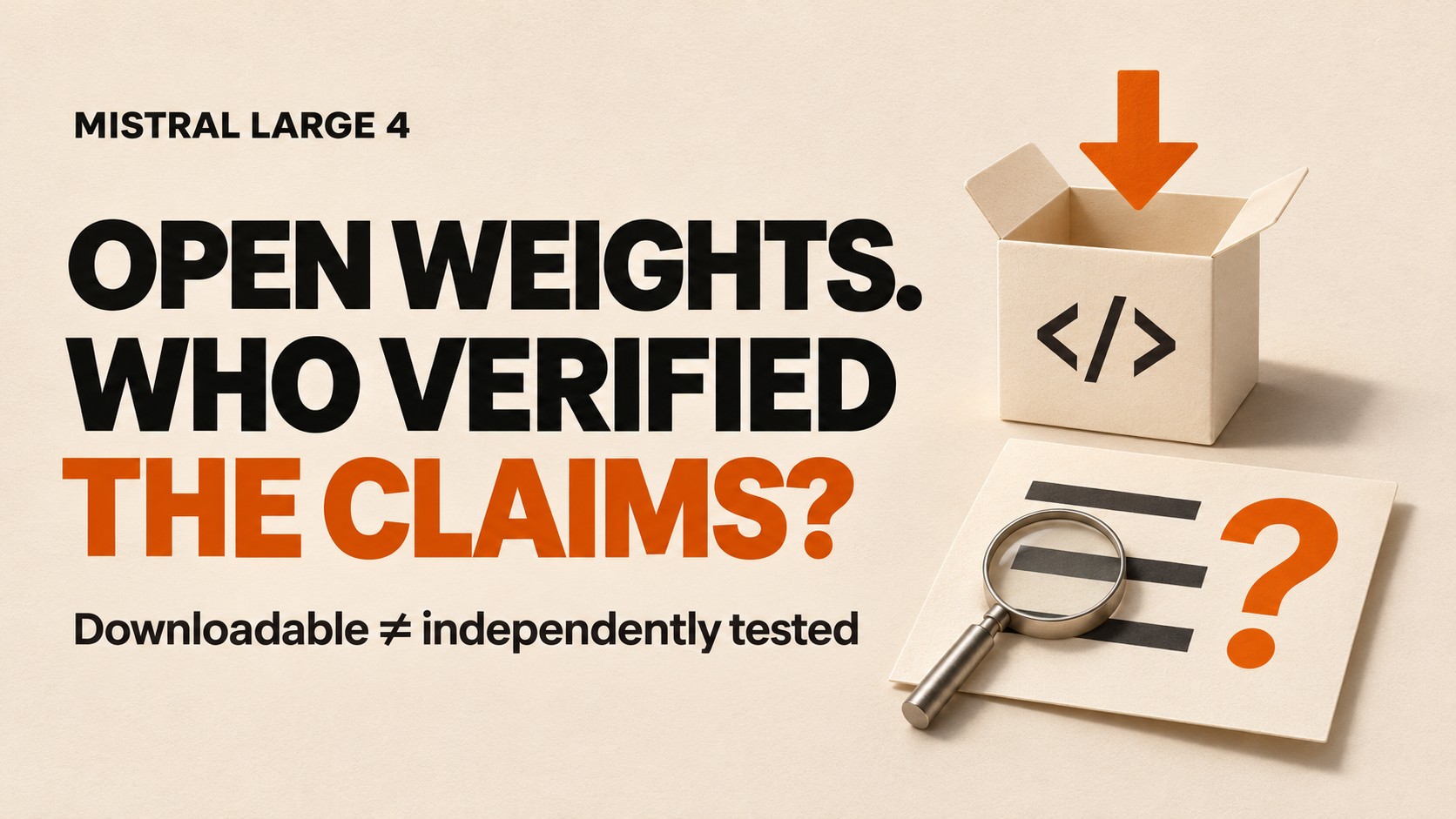

Mistral released the weights for Large 4 on Hugging Face on October 29, three weeks after the public preview, according to NYU Shanghai's Research and Instructional Technology Services. The official repository includes the weight files, a model card, licence information and deployment instructions. Its name, Mistral-Large-4-1T-A52B, follows the usual mixture-of-experts naming: about 1 trillion parameters in total, with about 52 billion active for each token. That would make it one of the largest open-weight models anyone has released.
Mistral's release announcement says Large 4 improves on coding and defensive cybersecurity. NYU Shanghai's account describes the coding benchmark results as Mistral's own, and nothing in the available sources shows an independent ranking against other open-weight coding models, or results on a real codebase or security workflow. That's normal for a release only weeks old. Open weights are what make outside checks possible, but none have been published yet.
The size matters in practice. A model with 52 billion active parameters is cheap to run per token compared with its total size, but all 1 trillion parameters still have to fit in memory. That puts the full model out of reach of a single workstation and of most small teams. The sources don't give hardware requirements or say which licence terms apply. Heavily compressed versions will make it easier to run, but each one needs its own testing, because compression costs a model's quality unevenly. Earlier this month, Bonsai 2 kept its aggregate score while its agentic-coding results fell.
For teams thinking about Large 4, the order of operations is simple. Read the licence and the model card's hardware guidance first. Then pick the configuration you can actually run, and test that configuration on your own coding and security tasks rather than relying on Mistral's numbers. Having the weights lets you check Mistral's claims. It doesn't confirm them.