Kimi K3.1 Pro

Moonshot Says Kimi K3.1 Pro Cut Cyber Training Data, Lowering Its Exploit Benchmark Score

In short

Moonshot says Kimi K3.1 Pro removed cyber material from training, reducing an internal exploit benchmark score while retaining coding ability.

161 views3 min readKainotomic Team

Moonshot Says Kimi K3.1 Pro Cut Cyber Training Data, Lowering Its Exploit Benchmark Score

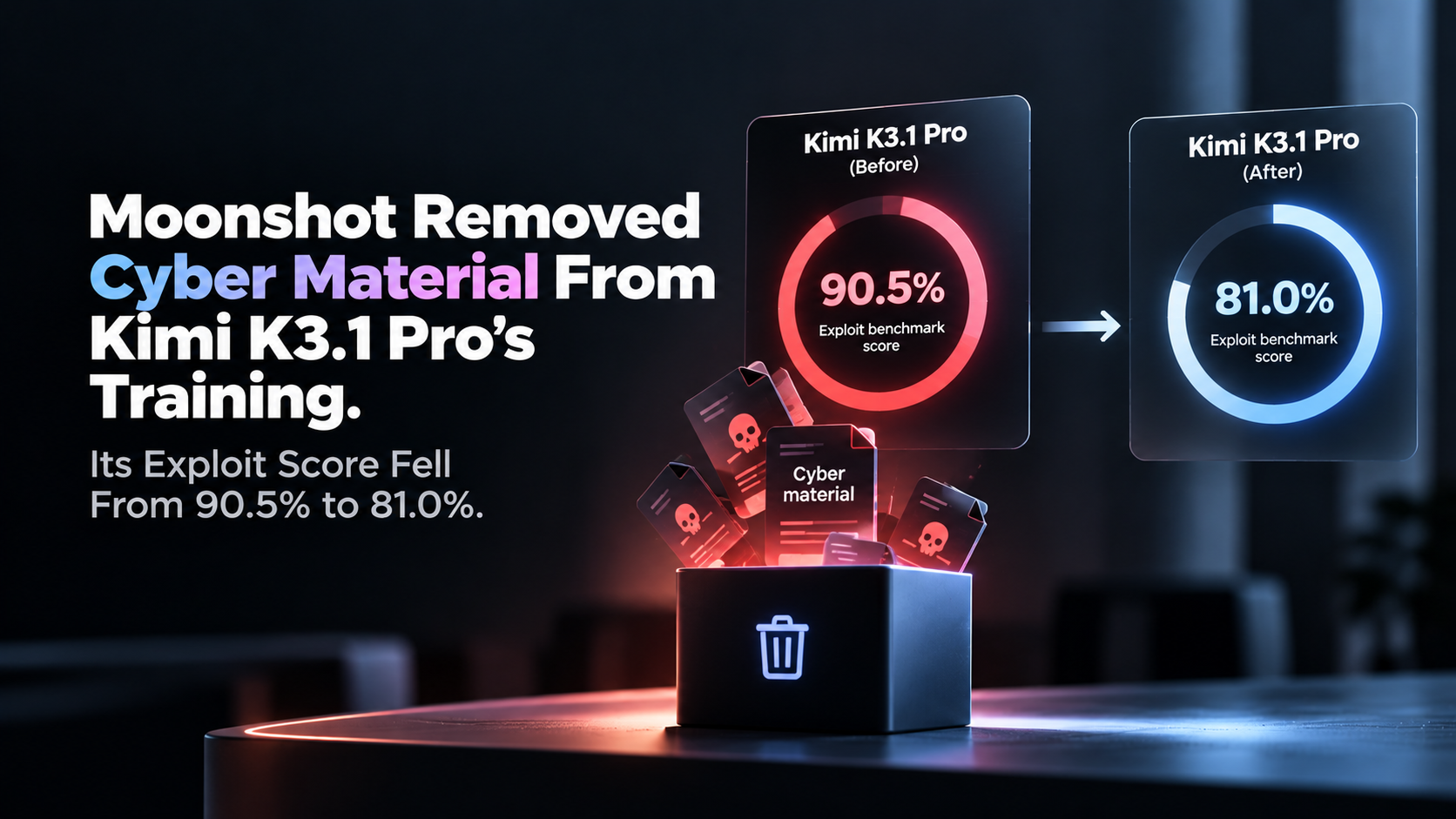
Moonshot AI says it removed cyber-related material during both mid-training and reinforcement learning for the open-weight release of Kimi K3.1 Pro. The company says the change reduced the model’s score on its internal exploit benchmark from 90.5% to 81.0%. Moonshot AI

That is a more concrete safety claim than a generic promise to make a model “responsible”: Moonshot has attached a numerical before-and-after result to a specific training-data intervention. But the available disclosure also leaves important questions unanswered. Moonshot does not establish, in the cited material, what its exploit benchmark contains, how representative it is of real-world offensive capability, or whether outside researchers have reproduced the result. Moonshot AI

The company’s approach is notable because it targets capabilities during model development rather than relying only on controls after release. According to Moonshot, cyber-related data was excluded in mid-training and cyber tasks were filtered from reinforcement learning. Moonshot AI VentureBeat independently reported Moonshot’s account that the company removed cybersecurity training material and filtered reinforcement-learning tasks, while saying the company sought to retain broader coding ability. VentureBeat

A capability trade-off, not proof of safety

The reported 9.5-point drop is evidence that Moonshot’s internal evaluation detected less exploit-related performance after the intervention. It is not, by itself, evidence that K3.1 Pro cannot assist with harmful cyber activity. A benchmark score measures performance against the benchmark’s own tasks; the supplied information does not show the test set, scoring rules, model configurations, or results from independent evaluators. Moonshot AI

Nor do the cited materials establish how much useful defensive-security work may have been affected. Cybersecurity knowledge is often dual-use: the same concepts can support vulnerability remediation, penetration testing, incident response, and misuse. Moonshot’s published claim is that it filtered cyber-related material, while VentureBeat reports that it preserved broader coding capability; neither source, as provided, quantifies the resulting effect on legitimate security workflows. Moonshot AI VentureBeat

That missing detail matters especially for an open-weight model. Once weights are distributed, providers have fewer opportunities to apply centrally managed product controls. Training-time choices can therefore become a significant part of a release’s safety posture. Moonshot’s announcement demonstrates an attempt to make that trade-off before release, but it does not provide enough public evidence to independently judge the intervention’s effectiveness or its broader costs. Moonshot AI

Vitalik Buterin’s reported position focuses on uses

TechFlow reported that Ethereum co-founder Vitalik Buterin supported proactively excluding top offensive-cyber capabilities from Kimi 3.1’s training. Its account characterizes his position as preferring restrictions on dangerous use cases rather than restrictions based on who is allowed to use a model. TechFlow

That framing aligns with Moonshot’s stated intervention: reduce a category of harmful capability at training time, rather than presenting identity-based access restrictions as the primary answer. However, the cited TechFlow report is the available basis for the attribution here; the supplied sources do not include a direct statement from Buterin, nor do they establish his view on every deployment or access-control policy. TechFlow

The strongest conclusion supported by the public material is limited but meaningful. Moonshot says it made a deliberate training change to reduce exploit-oriented performance in Kimi K3.1 Pro, and it reports a lower score on an internal benchmark after doing so. Moonshot AI The company has not yet supplied enough detail for outsiders to verify whether the reported reduction translates into substantially lower real-world misuse risk—or whether the filtering preserves the full range of defensive security work developers may expect.

For open-weight AI releases, that is the test that should follow: not whether a model maker claims a safety trade-off exists, but whether it publishes the evaluations, definitions, and independent evidence needed to inspect it.

Sources

Kimi / Moonshot AI

View source

Topics

  • Kimi K3.1 Pro
  • Moonshot AI
  • Vitalik Buterin
  • cybersecurity
View all news