
OpenAI Says Its Cheapest New Model Performs Almost Like Its Best One — At a Fifth of the Price
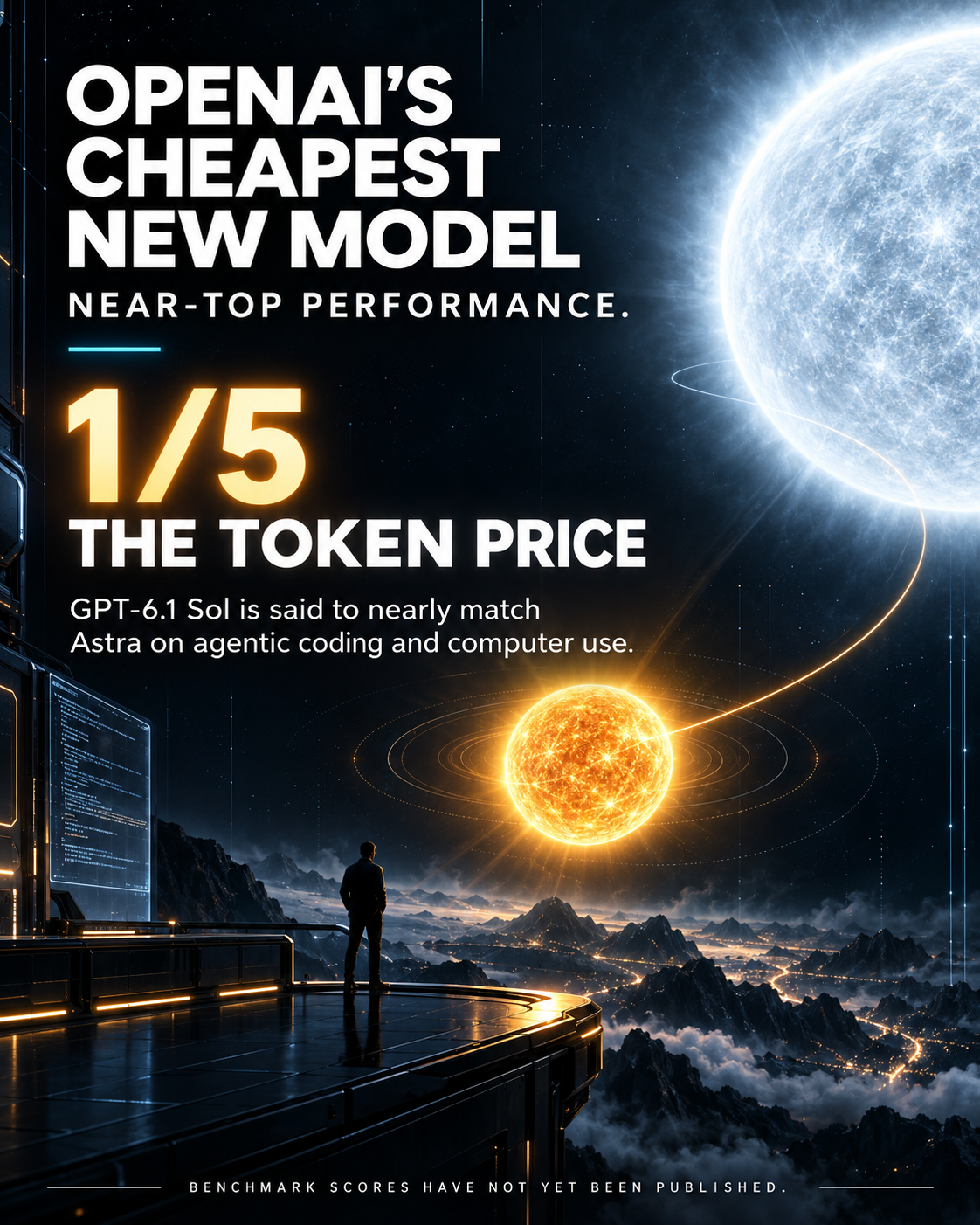
OpenAI says GPT-6.1 Sol nearly matches Astra on agentic coding and computer use at one-fifth the token price. No benchmark scores have been published yet.
OpenAI says its new GPT-6.1 Sol API model nearly matches GPT-6 Astra on agentic coding, computer use, and professional-work tasks — at one-fifth the standard token price. If that holds up in real deployments, it's a meaningful cost option for developers running those workloads at scale. OpenAI also lists cached-input pricing at $0.10 per million tokens, a 95% discount from Sol's standard rate, which could matter for applications that repeatedly reuse stable context like system instructions or codebase material.
TechCrunch confirms OpenAI presented this same positioning at DevDay — so the claim is real and public. What's missing is everything that would let anyone verify it. OpenAI's announcement doesn't include benchmark scores, task definitions, sample sizes, error rates, or any detail on where Sol actually falls short of Astra. "Near-Astra performance" is OpenAI's own framing, not an independently measured result.
That gap matters because a lower per-token price doesn't automatically mean a lower total cost. Nothing published so far addresses latency, output length, retry rates, reasoning-token consumption, or how often Sol falls back to a more expensive model on harder tasks. An agent workflow's real cost depends on all of those, not just the sticker price per token — and none of it has been quantified here.
There's also an open implementation question: OpenAI's documentation covers Sol's capabilities and pricing, but the available material doesn't confirm whether it supports every endpoint, tool, or migration path an existing Astra-based integration would need.
Bottom line: This is a specific, testable pricing and performance claim, not a demonstrated Astra replacement. Developers evaluating Sol should treat it as something to benchmark directly against their own workloads, comparing task success, tool-call reliability, total token use, and fallback behavior, rather than assuming the one-fifth price tag translates directly into one-fifth the cost of running their actual agent.
- 1
OpenAI says its new GPT 6.1 Sol API model nearly matches GPT 6 Astra on agentic coding, computer use, and professional work tasks — at one fifth the standard token price.
- 2
If that holds up in real deployments, it's a meaningful cost option for developers running those workloads at scale.
- 3
TechCrunch confirms OpenAI presented this same positioning at DevDay — so the claim is real and public.
Continue reading