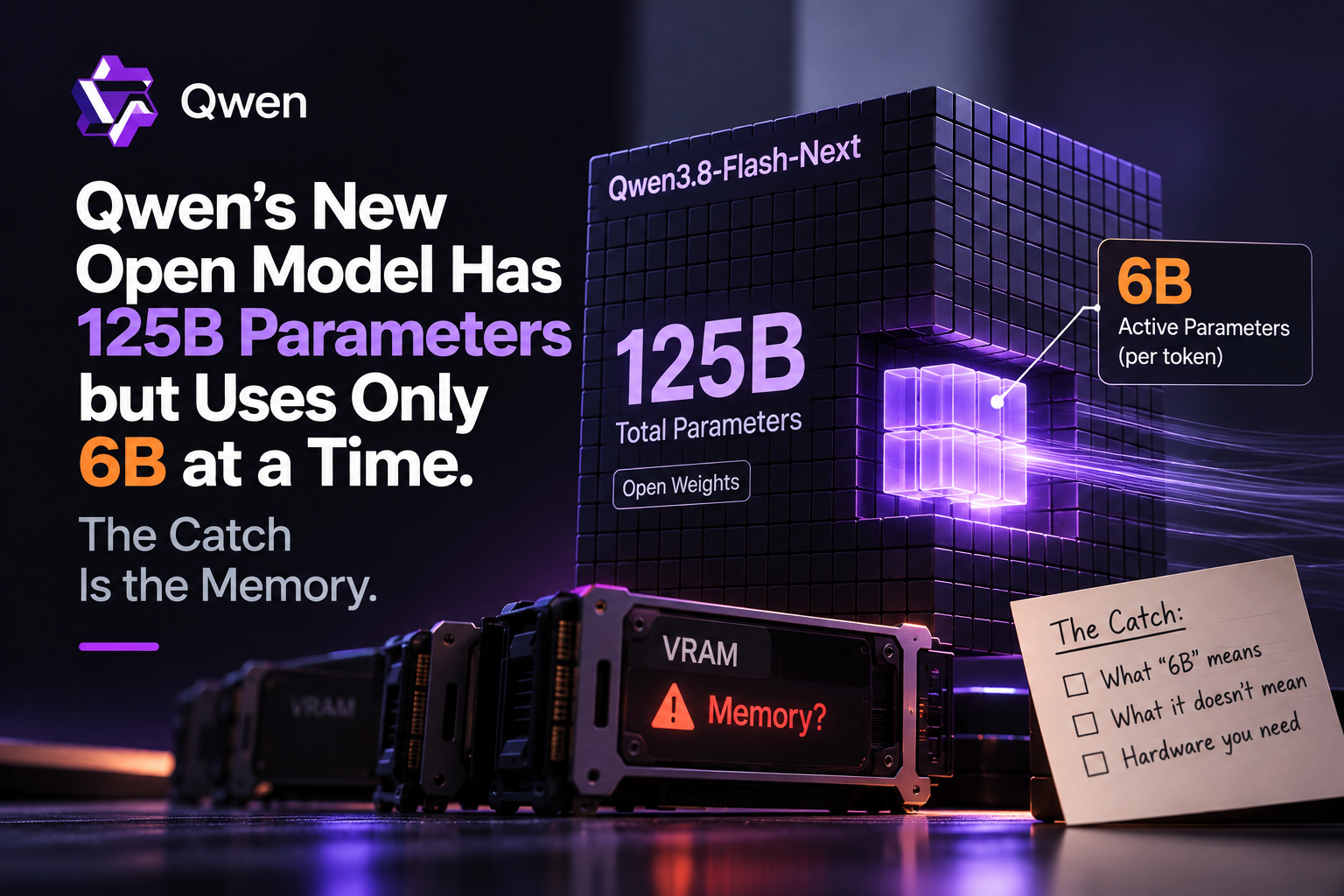

Qwen’s New Open Model Has 125B Parameters but Uses Only 6B at a Time. The Catch Is the Memory.
Qwen3.8-Flash-Next is an open-weight 125B MoE model with 6B active parameters per token. Here’s what the “6B” does and doesn’t mean for the hardware you need.
Qwen has released open weights for Qwen3.8-Flash-Next, a multimodal mixture-of-experts model with 125 billion total parameters and 6 billion active per token. Qwen describes it as a preview of its forthcoming Qwen4 architecture, not a routine update. Coverage dates the release to late August 2026, with weights on Hugging Face and ModelScope. NVIDIA has published a deployment recipe for it, so the release is easy to verify. Qwen3.8-Flash-Next: Features, Benchmarks, and Pricing +2
“6B active” is about compute, not memory. Sparse activation means each token uses only a small slice of the model, but all the weights still have to live somewhere. Qwen’s design adds a 51B-parameter n-gram embedding table that can be offloaded to host memory instead of GPU memory. That’s the most unusual part of the architecture, and it changes how you plan hardware: you have to account for the active expert weights, the offloaded table, and the transfers between them.
The published numbers show the gap:
NVIDIA’s recipe uses an NVFP4 quantization that needs roughly 130 GB of VRAM at minimum, deployed on four B200 GPUs. nvidia A community 4-bit quantization comes to about 77 GB of weights spread across four 32 GB GPUs, and its card warns that a machine with enough VRAM but too little system RAM can hold the weights yet fail to load the table. huggingface Sources also disagree on how to count it. NVIDIA’s documentation counts the 51B table inside the 125B total. Another write-up treats it as extra, putting the total to hold near 176B. Check the model card for your setup before sizing hardware. nvidia yottalabs
Treat the performance claims as vendor claims. Qwen’s paper says Flash-Next used roughly one-ninth of its predecessor’s training FLOPs. That’s a meaningful efficiency claim, but FLOPs aren’t a full cost accounting. They leave out wall-clock time, hardware use, data preparation, and failed runs. Some third-party coverage says the model beats Claude Opus 4.6 Max on most practical coding and agent evaluations. Other coverage notes that these benchmark numbers are all vendor-reported, with no independent replication yet. Qwen’s materials don’t give reproducible latency, throughput, or batch-size results for a named hardware setup either. datacamp yottalabs
Bottom line: Flash-Next is a real, downloadable open-weight release with an interesting bet: keep a very large table in cheap host memory so each token touches very little compute. That makes it cheaper per token, not necessarily easy to run, and the benchmark comparisons to frontier models still need independent testing. If you’re considering it, test it on your own hardware and your own tasks, and check the license terms before building on it.
- 1
Qwen has released open weights for Qwen3.8 Flash Next, a multimodal mixture of experts model with 125 billion total parameters and 6 billion active per token.
- 2
Qwen describes it as a preview of its forthcoming Qwen4 architecture, not a routine update.
- 3
Coverage dates the release to late August 2026, with weights on Hugging Face and ModelScope.
Continue reading