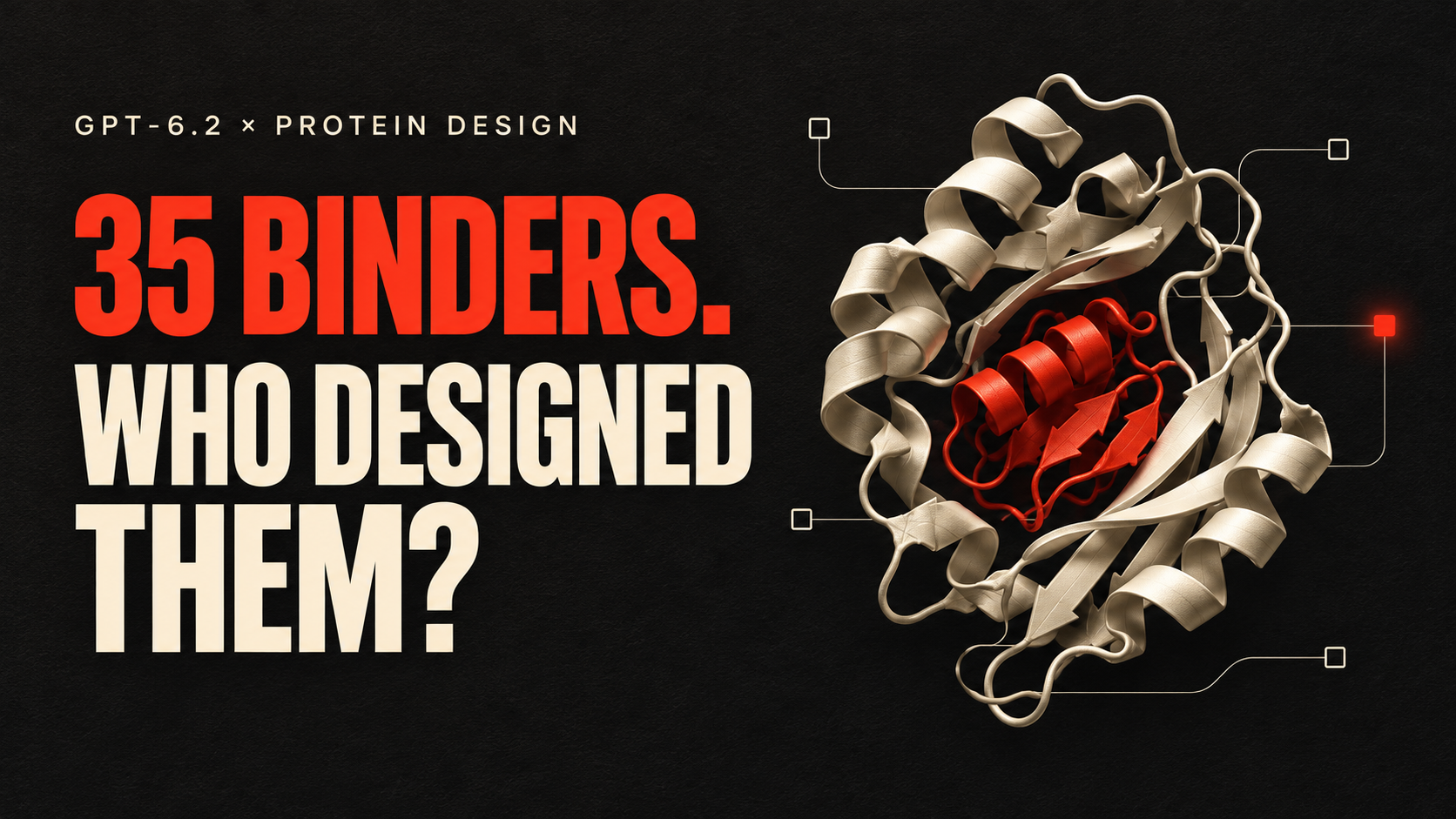

OpenAI says that 35 of 322 protein designs produced through a GPT-6.2-assisted workflow bound their intended targets in laboratory tests run by its research partner Onava. Binders were found for all five targets in the study. Nature put the result at roughly an 11 percent binding rate. OpenAI calls this evidence of "intrinsic protein design capabilities" in its GPT-6 models, and it links a preprint titled "GPT-6: a universal foundation model for protein biology" as the underlying research.
The workflow matters more than the number. According to OpenAI, GPT-6.2 used reasoning and code to generate protein structures. Specialist models then generated the amino-acid sequences for those structures and filtered the candidate pool before Onava's lab tested the selected designs. Every one of those stages, sequence generation, filtering and the wet lab, contributed to the 35-of-322 figure. The test measured the combined pipeline. It did not measure GPT-6.2 on its own, and the supplied sources don't say what the hit rate would have been with the structure-generation step done by a specialist tool instead.
That missing baseline is the central gap. The sources also don't say how the 35 binders were distributed across the five targets, which matters because "binders for all five" is consistent with 31 hits on one easy target and one each on the rest. And binding is a narrow result. It shows a protein attached to its target in a lab assay. It doesn't show the protein is stable under relevant conditions, works in a living organism or is a candidate medicine. Nature noted the continued role of specialist tools in reaching even this outcome.
For AI readers the useful takeaway is the pattern, not the rate. A general-purpose model was slotted into one stage of a specialist pipeline and the pipeline produced real, lab-validated hits. That's a legitimate milestone for a language model in a domain where the previous answer was "use AlphaFold-class tools." But the claim that GPT-6.2 has protein-design capability of its own needs an experiment this study didn't run: the same five targets, the same downstream tools, and the structure step swapped out. Until OpenAI or someone else publishes that comparison, 11 percent is the pipeline's score, applicable to this tested set and these conditions.