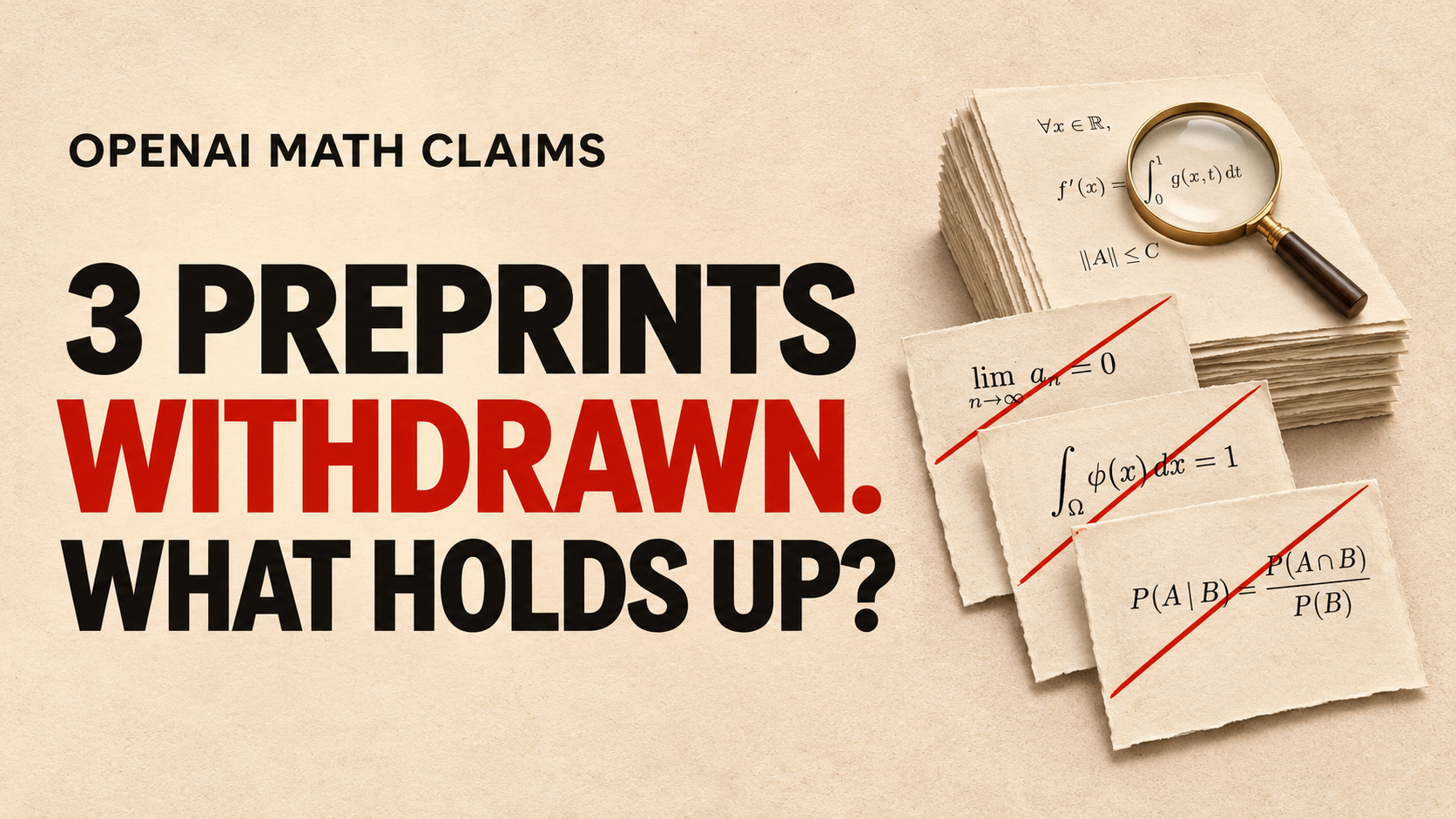

OpenAI released more than 700 mathematical preprints in early October, produced by an internal model and aimed at open problems. In less than a day it withdrew three of them because of errors, Retraction Watch reported. Secondary coverage traced the problem to a sign error in a paper on Weil classes on abelian eightfolds. The error invalidated a key step in that paper, and two papers that depended on it fell with it, including one on the Hodge conjecture for products of K3 surfaces. That left 719 manuscripts in the collection, with further proof repairs reported.
It's tempting to read the withdrawal as an error rate: three in 722 sounds like under half a percent. It isn't one. These three were caught because someone found a flaw in one paper and followed its dependencies. Nobody has shown that the other 719 have had the same scrutiny. OpenAI says many of the proofs include Lean formalizations, which a computer can check. But it hasn't said that all of them do. And for any single result, a formalization only helps if the checked statement matches the mathematical claim. A release this big isn't evidence the claims are correct. Three withdrawals aren't evidence the rest are wrong either.
The cost lands on mathematicians. Putting out 722 papers at once means the people qualified to check them have to sort through them, and in many subfields that's a handful of specialists. The Association for Human Mathematics criticized the bulk release and urged mathematicians to stop working with OpenAI, in a statement hosted on Terence Tao's website. That is the association's position. It doesn't show how widely mathematicians share the view.
For AI readers, this is useful background for the bigger claims that came later. Since this release, AI-assisted claims on the Riemann Hypothesis, the Exponential Time Hypothesis and VP ≠ VNP have arrived with Lean code and outside review. Those are the two things that were uneven or missing here. The question for the 722 papers is the same one those claims face, and it can only be answered paper by paper: what does each result claim, is the formal check complete, and has anyone outside OpenAI confirmed the argument holds?