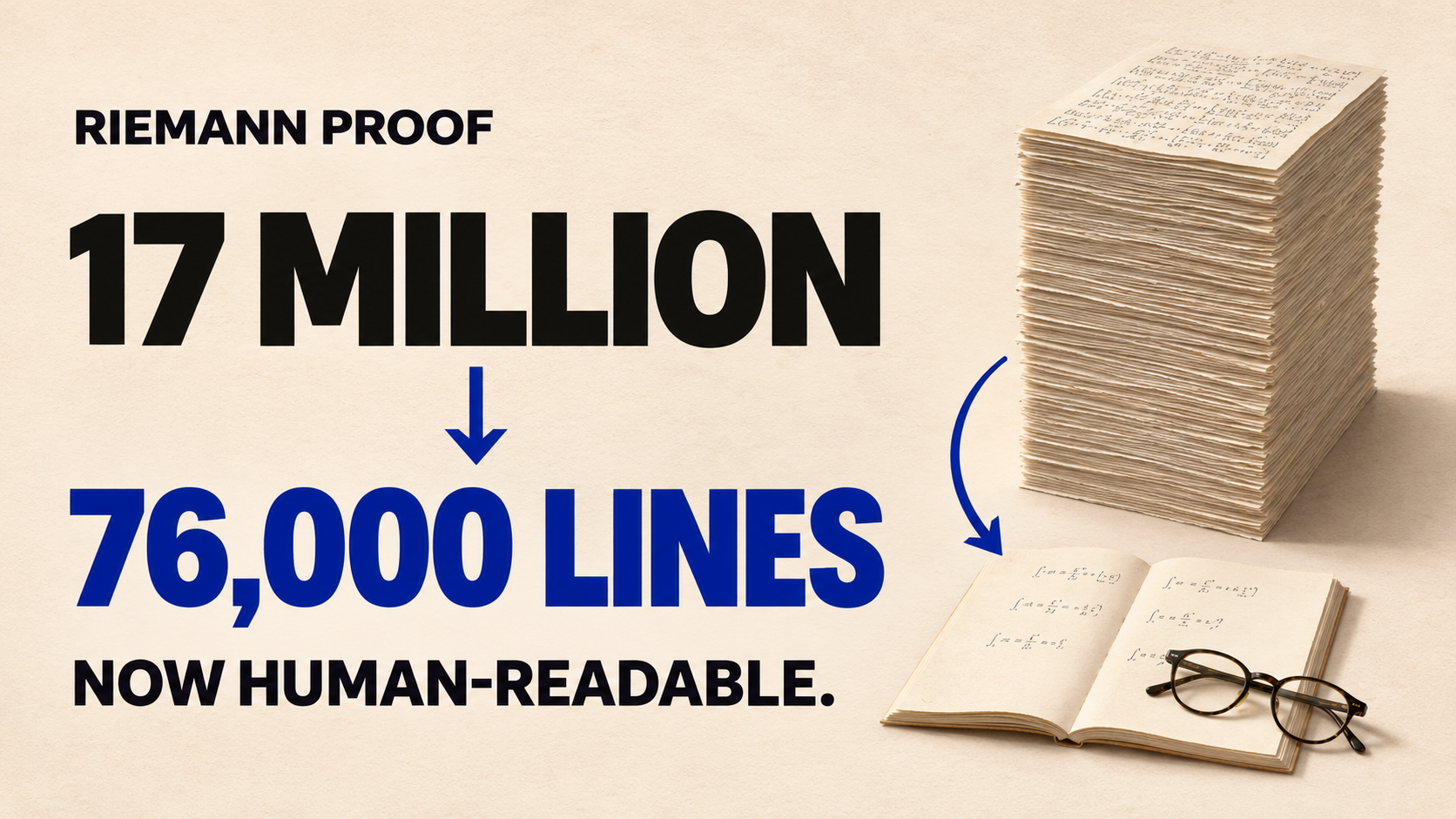

When Levent Alpöge announced a Claude-assisted proof of the Riemann Hypothesis and its generalized form on November 20, the formal version ran to about 17 million lines of Lean across 175,187 files. Lean checkers accepted it, but no person could read something that size. Five days later, Luke Sernau published a rewrite in a repository called grh-lean, describing it as a Claude-assisted rendering of Alpöge's proof. It comes in two editions: a compact one of about 76,000 lines and a readable one of about 300,000. The compact edition is less than one percent the size of the original.
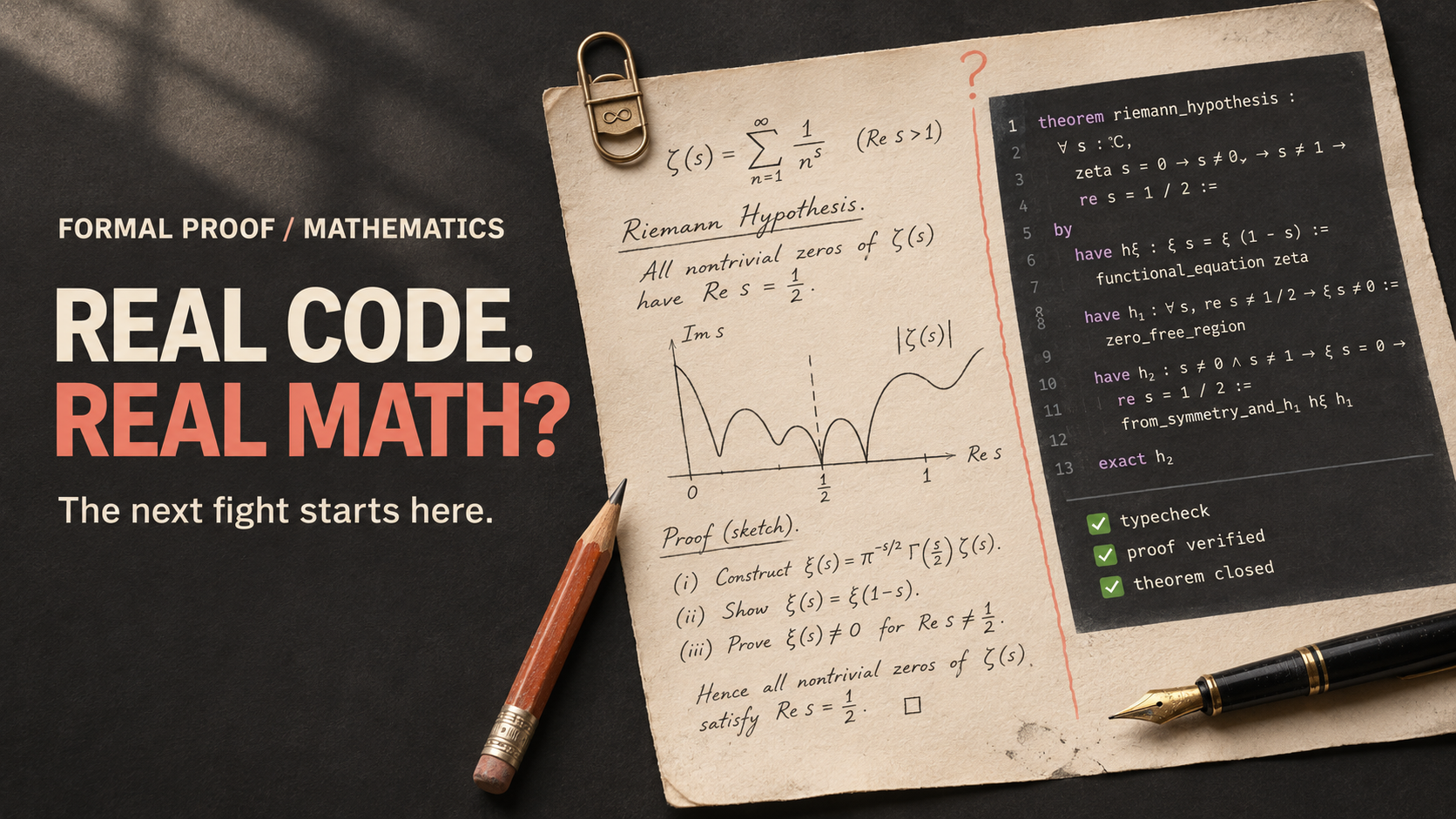
The important part is what was checked. Andrew Sutherland at MIT, who verified the original, says he checked both new editions against the same five theorem statements as the 17-million-line version, and both passed. That's more than saying the new files compile. A shorter proof could easily prove a slightly different, weaker statement and still compile. Checking the same statements rules that out at the formal level: the short version claims exactly what the long one did.
The rewrite doesn't show that the underlying mathematics is simpler. Much of 17 million lines can be generated scaffolding, repetition and brute-force steps that a rewrite removes without changing the argument. It also doesn't change where things stand with mathematicians. The research registry What AI Found says no mathematician has yet read through the shorter argument. The registry also separates this claim from an unrelated, human-written Riemann Hypothesis draft by Alessandro Masullo, which it says has reported problems. Sutherland's checks apply only to the Alpöge-based work.
For AI readers, the shrink matters more than any benchmark number this week. The strongest reason for caution about the original was that no human could review 17 million lines. A model has now compressed it to something about the size of a long paper, with the formal guarantees intact. That doesn't make the proof accepted, but it means acceptance now depends on mathematicians reading 76,000 lines rather than on whether anyone could read the proof at all. The next milestone is a mathematician's read-through, not another machine check.