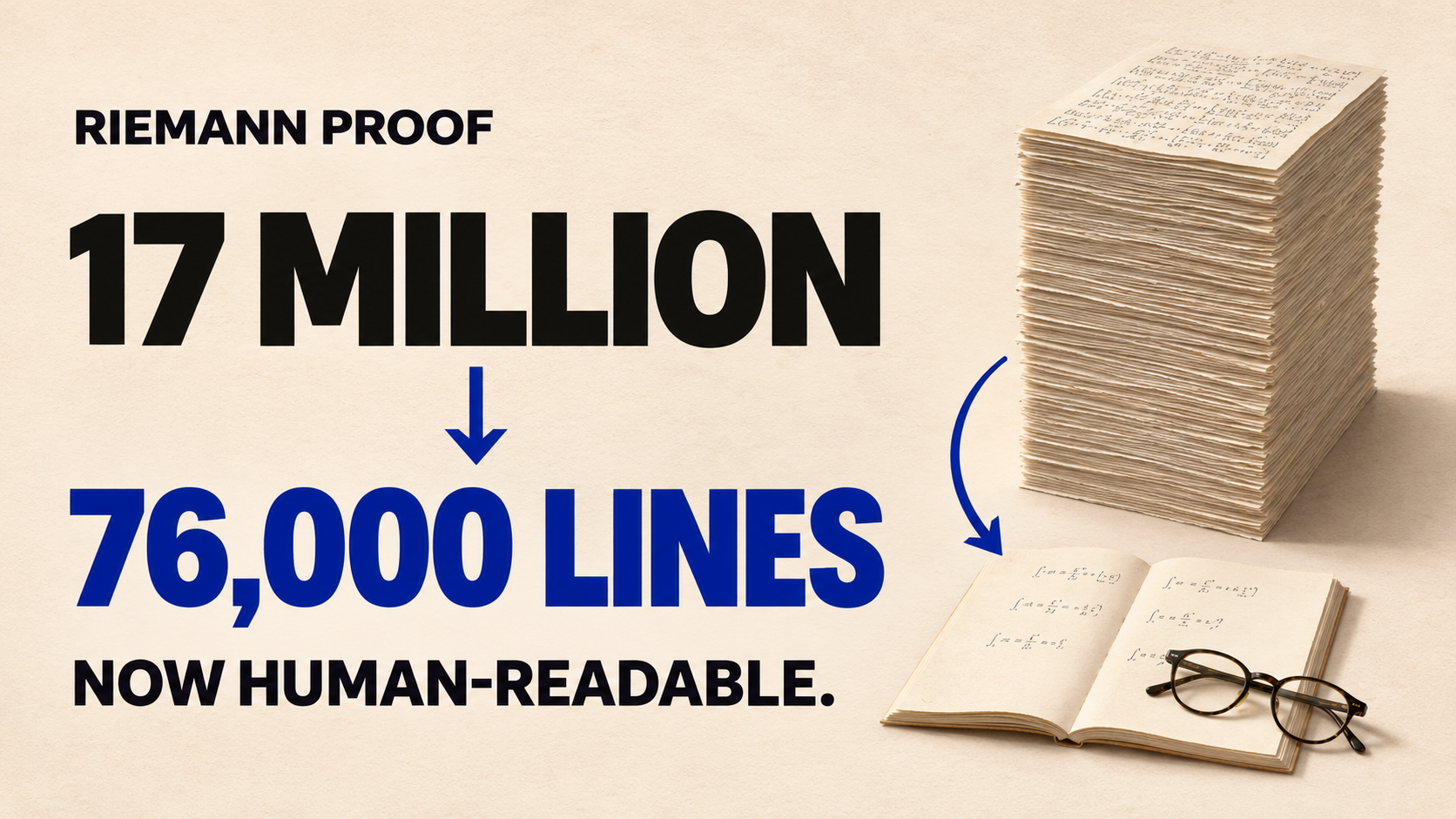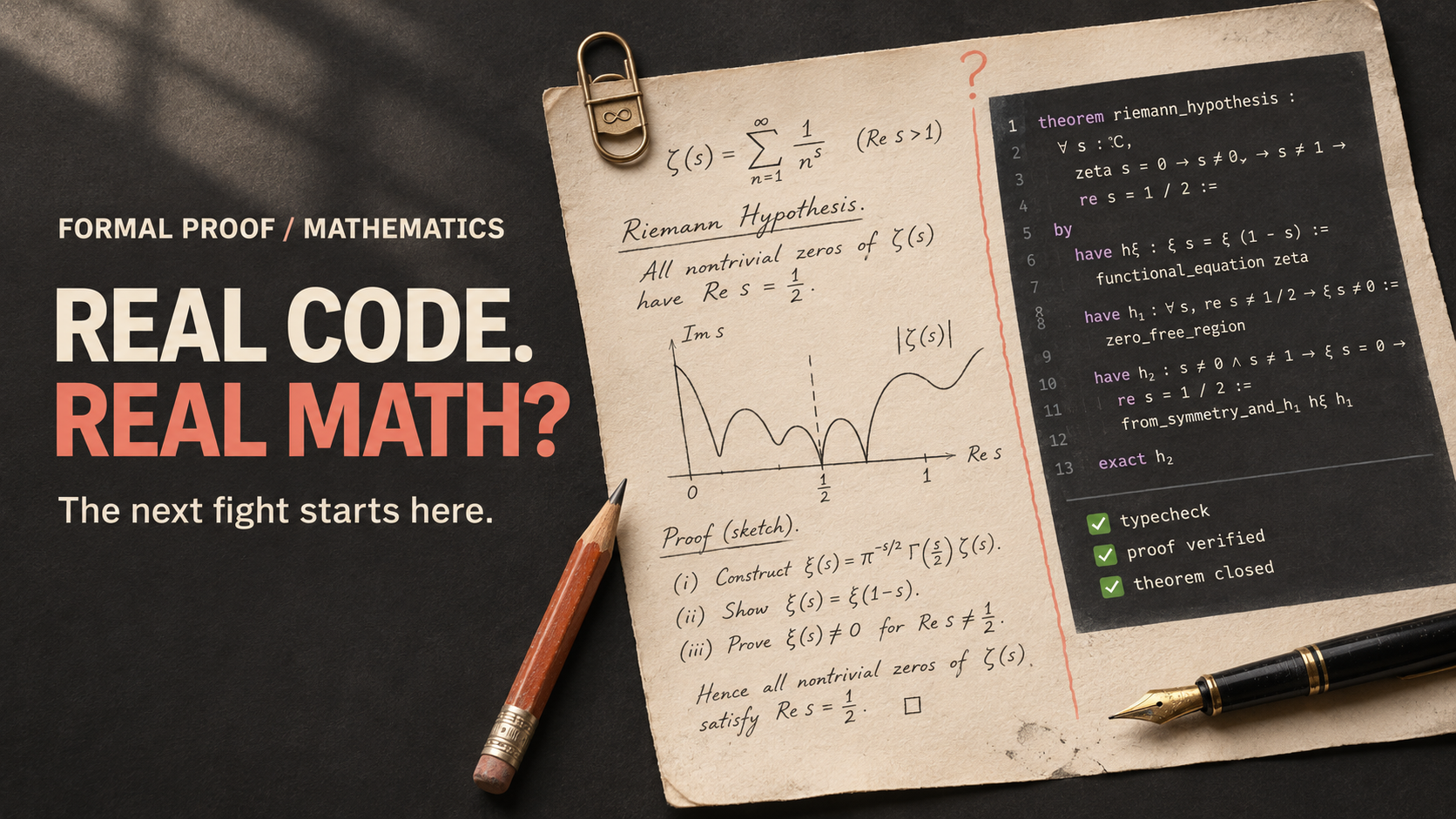

Levent Alpöge announced on November 20 that he and Claude had found proofs of the Riemann Hypothesis and its generalized form for Dirichlet L-functions, and that the arguments had been formalized in Lean without extra assumptions. The Riemann Hypothesis is a Clay Millennium Prize Problem and one of the best-known open questions in mathematics, so the claim is extraordinary on its face. What separates it from most big announcements is that the proof exists as a machine-readable object: about 17 million lines of Lean spread across 175,187 files, published for anyone to replay.
The Lean and Mathlib communities said on November 21 that the library had been checked and that it certifies both the formal statement and the proof. Andrew Sutherland at MIT went further and published a verification log: the proof compiles, the axioms it relies on have been audited, Lean's own kernel replays it, and two independently written kernels also accept it. Those checks target different failure modes. A proof that only works in one implementation, or that quietly imports an unexpected assumption, would have failed one of them. Sutherland's page also says two more checks were still in progress when it was written.
Here is what that does and does not settle. A proof assistant verifies that the encoded derivation follows from the encoded statement under the stated rules, and it does that with a precision no human referee can apply to 17 million lines. What it cannot tell you is whether the encoded statement is the theorem everyone means by the Riemann Hypothesis, whether the informal ideas behind the formal proof are understood by anyone other than the author and the model, or whether the argument is new. Those questions belong to mathematicians, and the Associated Press, citing the Clay Mathematics Institute, reports that the path from announcement to broad understanding of a result this size takes time. Nothing in the public record shows the Clay Institute recognizing the claim as a solution to the prize problem.
For AI readers the useful lesson is the one your AlphaProof and Axiom coverage already set up. Lean is a strong filter: it has turned "I believe I have a proof" into "a formal object passed kernel-level checks," and that is a real milestone for formal mathematics regardless of whether a model was involved. But the headline-worthy event, mathematicians agreeing the Riemann Hypothesis is proven, has not happened. Until the remaining checks finish and number theorists have read the argument, the accurate description is a claimed proof with an unusually strong verification record.