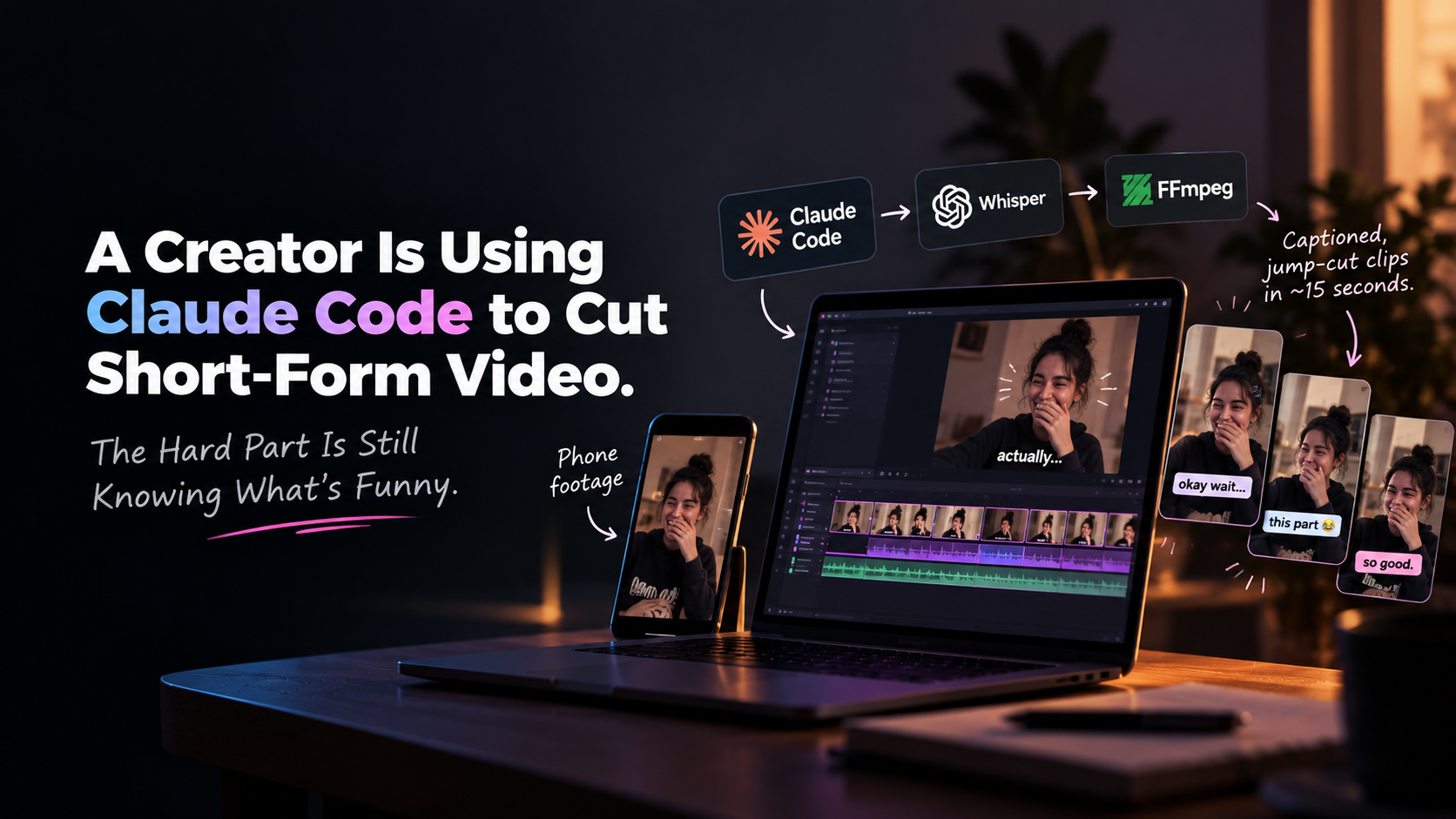

Creator Brooke Lacey has built a short-form video-editing setup that uses Claude Code to coordinate transcription, editing decisions, and rendering tools. Lacey told Lenny’s Newsletter it can turn raw phone footage into a captioned, jump-cut video in about 15 seconds.
Claude Code isn’t cutting the video itself. According to Lenny’s Newsletter, it works alongside OpenAI Whisper, which transcribes the speech, and FFmpeg, which does the media processing. Claude Code supplies the reasoning and coding layer: it interprets the material and directs the other tools. ChatPRD describes a more detailed version that also uses Python for silence detection, word-level timestamps, face tracking, cut-list creation, captioning, and render checks. Together those steps cover familiar editing tasks: finding speech, removing pauses, selecting a section, cropping the speaker for vertical video, and timing captions to spoken words.
The useful idea is orchestration. The video gets converted into things software can process, such as transcripts, timestamps, silence markers, and editing instructions, and Claude Code turns those into commands that FFmpeg renders. FFmpeg and Whisper have long been capable of this, but combining them was hard for non-specialists. ChatPRD says the process also produces cut lists and render checks, so a creator can inspect the choices, change the instructions, and rerun the edit instead of accepting a one-click result.
What stays hard. ChatPRD frames the central challenge as teaching Claude Code what is funny, and the limit goes beyond comedy. A transcript shows words and pauses, but not whether a reaction shot matters, whether a pause adds emphasis, or whether a cut hurts a performance’s rhythm. A system can remove a long silence, but it can’t be assumed to know whether that silence is awkward, suspenseful, or the punchline.
What the accounts don’t show:
How often the intermediate results need manual correction, or error rates for transcription, face tracking, and caption timing. How the output compares with a professional editor’s work. A fast export isn’t necessarily a publishable edit. The footage length, computer hardware, model settings, or failure rates behind the 15-second figure. It’s one creator’s result in one environment, not a general benchmark. That the full setup is free or private. Local transcription and rendering take hardware and time, Claude Code access can carry costs, and where data goes depends on how each tool and connected service is configured.
Bottom line: Lacey’s setup shows where coding assistants can help creators: not by replacing creative judgment, but by making a programmable editing workflow easier to build and run. The strongest use is repetitive production work, such as a first cut, trimmed dead space, captions, and a version a human can review. The evidence supports that narrower claim, not the idea that a model can reliably stand in for an editor.