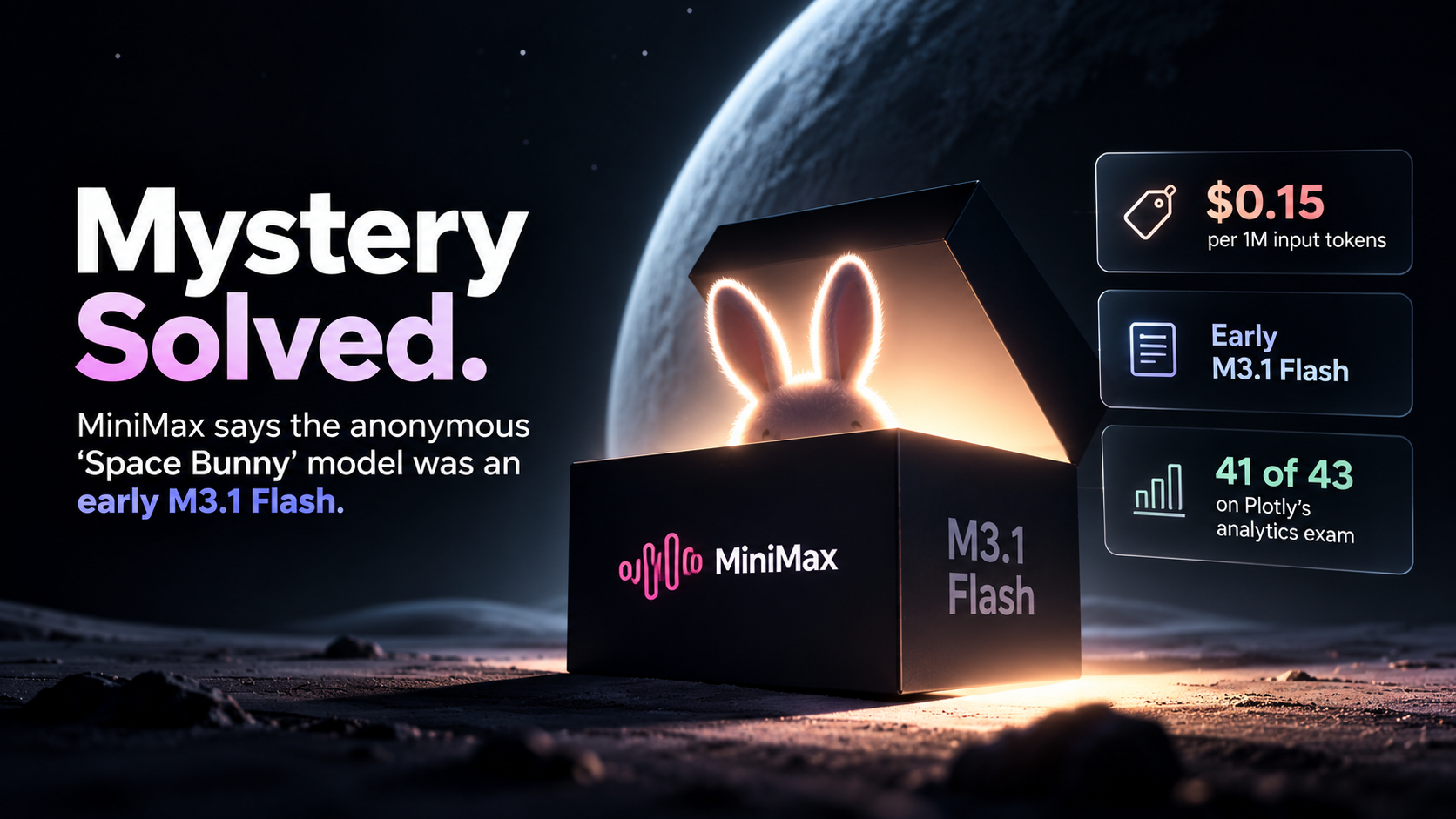

MiniMax has formally identified Space Bunny as an early version of its newly launched M3.1 Flash model. That resolves the question of who built the anonymous model that appeared earlier on OpenRouter, where public pages didn’t name its maker. The identification comes from MiniMax itself, in its English announcement, so it isn’t third-party speculation.
M3.1 Flash is positioned for coding and agent workloads, with listed API pricing of $0.15 per million input tokens and $0.60 per million output tokens. MiniMax’s Chinese-language announcement frames the same release around agent performance, speed, and lower task costs. The pitch is economic: agents may call a model many times during one task, so price per call matters more than it does for a single chat reply.
The claims are MiniMax’s own. The launch materials emphasize coding benchmarks, agent-task performance, throughput, and reduced costs. In the supplied materials those figures are vendor-reported. They show MiniMax is making the comparisons, but they don’t show M3.1 Flash consistently beating other models in production. A low per-token rate also doesn’t set the total cost of running an agent, which depends on retries, how much context each step sends, whether tool calls succeed, and the infrastructure around the model. None of that is established here.
One outside data point. Plotly says the released M3.1 Flash scored 41 out of 43 on its data-analytics exam, and says MiniMax confirmed to Plotly that Space Bunny was an early M3.1 Flash. That’s a result from a company other than MiniMax on a defined class of tasks. Still, the material doesn’t describe the exam’s task mix, model settings, comparison set, or how to reproduce it. So the score shows strong performance on that test, not on software engineering broadly, long-running autonomous work, tool use, or general reasoning. It also says nothing about how the model behaves when an agent fails midway, hits an unreliable tool, or gets ambiguous instructions.
Bottom line: MiniMax has made two checkable commitments: M3.1 Flash is the released successor to the Space Bunny build, and it’s offered at the listed prices. Plotly’s 41-of-43 result adds an encouraging but narrow observation. That’s enough to justify hands-on testing, not a verdict that M3.1 Flash has displaced established coding models. Whether the advertised economics hold up depends on independent tests across varied coding, tool-use, and long-context workloads.