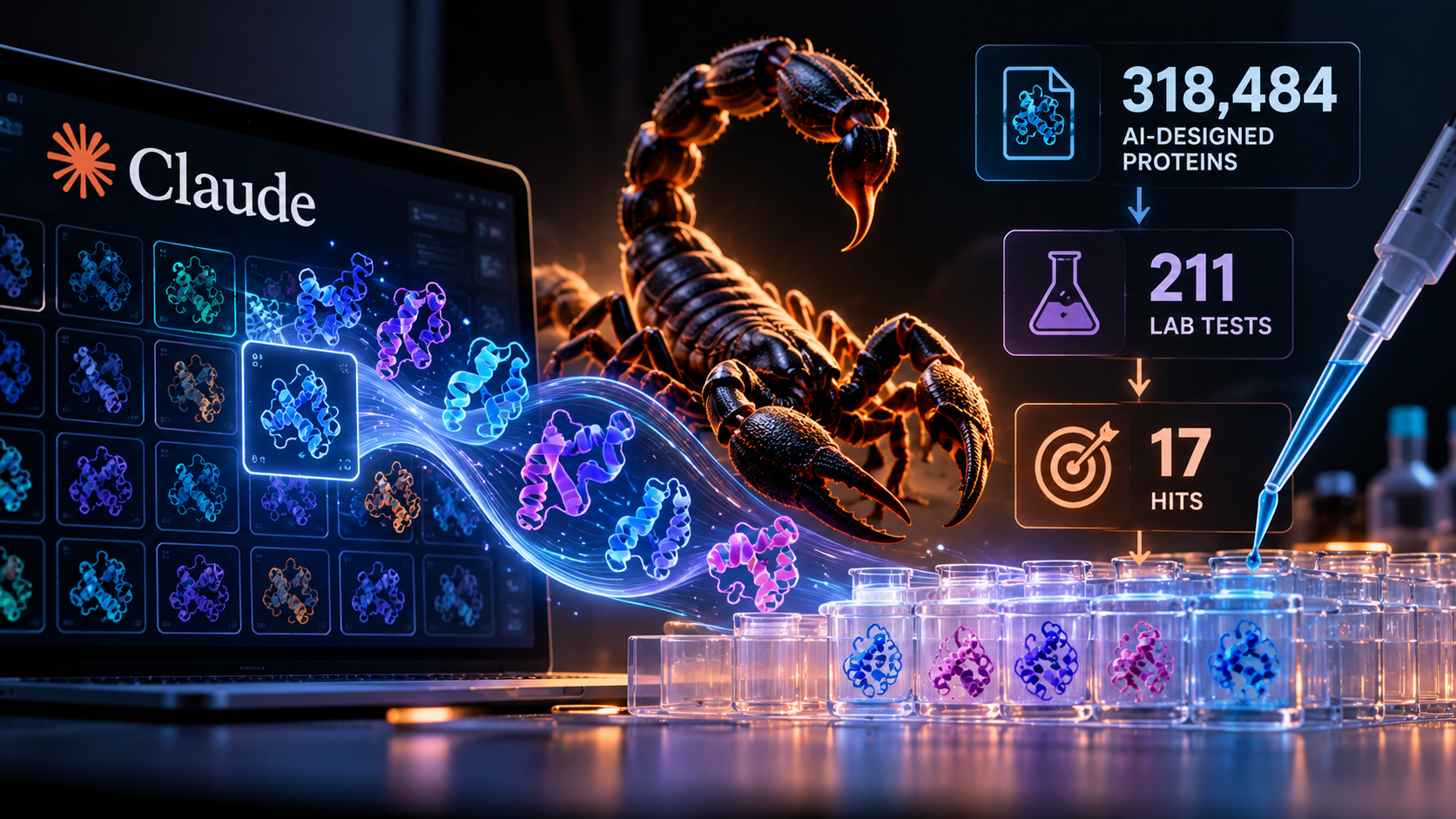

Anthropic says its Claude Science system produced 17 protein designs that met laboratory binding criteria for Cn2, a neurotoxin from a Mexican scorpion. The result shows that an AI-assisted workflow can generate proteins that stick to a chosen target. It doesn’t show that any of them neutralizes venom or works as an antivenom.
The numbers describe a funnel. According to Anthropic, Claude Science generated 318,484 candidate “minibinders,” small designed proteins meant to attach to a specific target. Researchers selected 211 of them for lab testing, and 17 met Anthropic’s reported binding criteria. The Decoder reports the same figures and says the two strongest candidates bound Cn2 very tightly.
That makes this more than a model-only claim, because the candidates were physically tested and some did bind the toxin. Two cautions on reading the numbers: the 17 hits come from the 211 designs that were tested, not from all 318,484, so they don’t measure how often the system succeeds across everything it generates. And the material doesn’t spell out what the binding criteria were.
Binding isn’t neutralizing. Think of a key that fits a lock versus a key that opens the door. A protein that sticks to an isolated toxin in a lab test hasn’t been shown to stop that toxin from harming a body. Anthropic explicitly says the experiments don’t establish an antivenom, and TokenPost likewise reports that venom neutralization hasn’t been demonstrated.
What remains open. The reporting doesn’t say whether the candidates work against whole venom, which contains many components beyond Cn2. It doesn’t compare them with existing treatments, and it gives no evidence on safety or effectiveness in animals or people. Those are the steps that separate a lab result from a treatment.
Bottom line: This is a protein-design milestone, not a therapeutic one. Claude helped generate experimentally validated binders against a chosen scorpion neurotoxin, and that’s a real, checkable result. Whether any of those binders can neutralize venom, and whether they could ever become an antivenom, is a question for follow-up experiments that haven’t been reported.