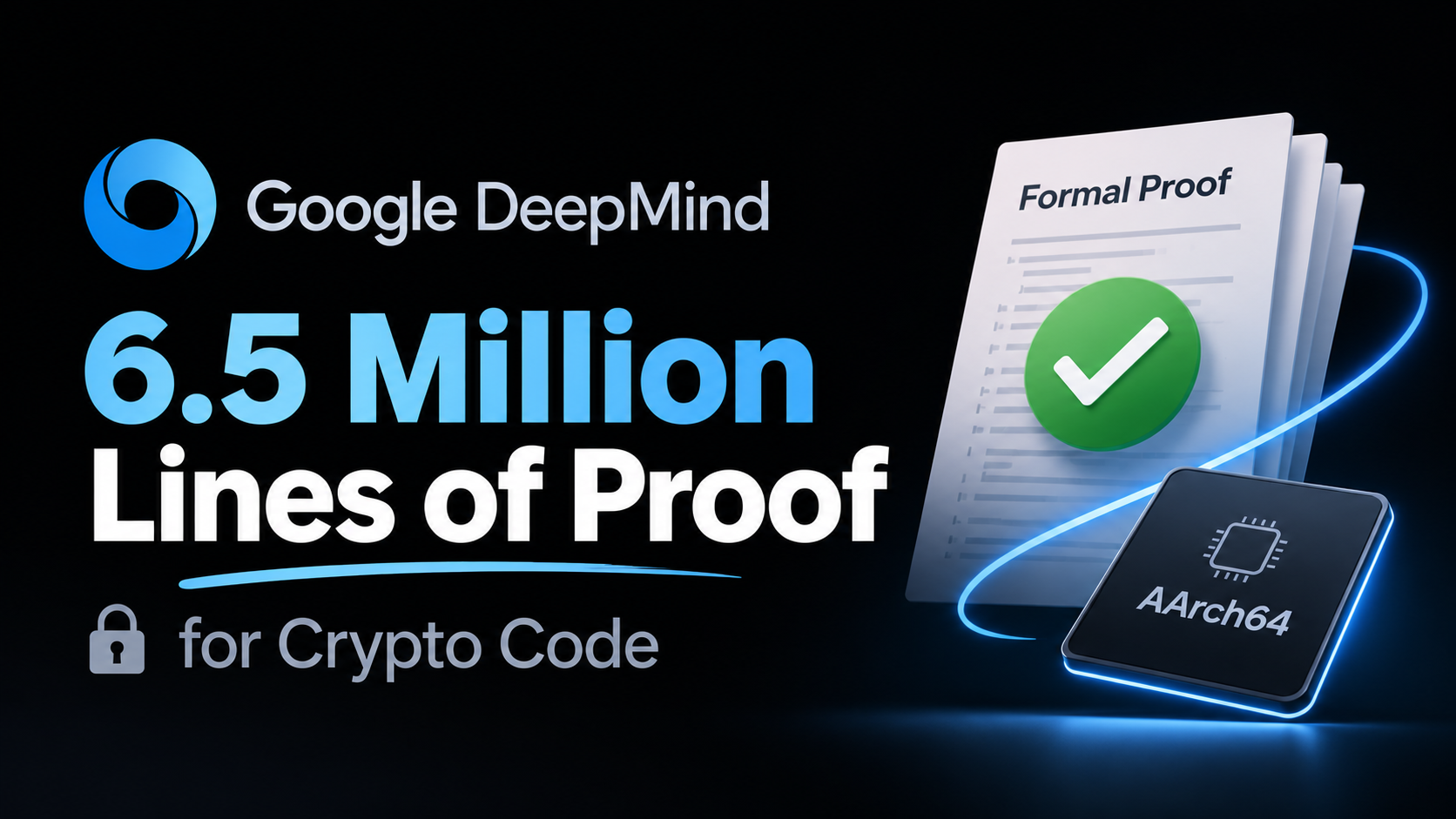

Google DeepMind has released AlphaProof Code, a human-guided, multi-agent framework that it says generated roughly 6.5 million lines of machine-checked Lean proof code for AArch64 cryptographic-library code. The notable part is the level. DeepMind says the proofs cover key security properties at the machine-code level, not only a higher-level implementation. That matters because a security argument about source code isn't necessarily an argument about the instructions that actually run, especially in architecture-specific code. DeepMind's release is aimed at closing that gap for the AArch64 implementation it examined.
DeepMind says the system uses Gemini Carbon in a multi-agent workflow with human guidance. It describes a framework for producing formal proofs, not a fully autonomous verifier that takes arbitrary software and returns a security guarantee. The output is Lean proof code that was machine checked, and that is the point that matters: the proofs are checked by Lean, not just generated by a model. But 6.5 million lines don't independently establish every security property a developer might care about. A formal result depends on its definitions, specifications, assumptions and the scope of the code covered. What DeepMind's materials support is narrower: machine-checked proofs of specified security properties for one AArch64 cryptographic implementation.
The artifacts are public. DeepMind has published a GitHub repository with the code and formal-verification artifacts, so researchers can examine the proofs and build material, which makes this more inspectable than a benchmark claim. Public isn't the same as validated. The materials don't establish that an outside security auditor has endorsed the proof scope, that anyone has replicated the result, or that other deployments using related software inherit the claimed properties. They also don't say how much expert human work the project took, compare it with a conventional formal-verification effort, or show equivalent results on unrelated codebases. The engineering question is whether teams can repeat this at an acceptable cost, not whether it can be done once.
So treat this as a substantial verification artifact and a promising workflow experiment. It isn't evidence that verification is now routine or push-button, and it isn't proof that AI has solved software assurance. The next evidence that matters is practical: independent examination of the proof boundaries, reproducible measurements of human effort, and comparable demonstrations on other high-value systems.