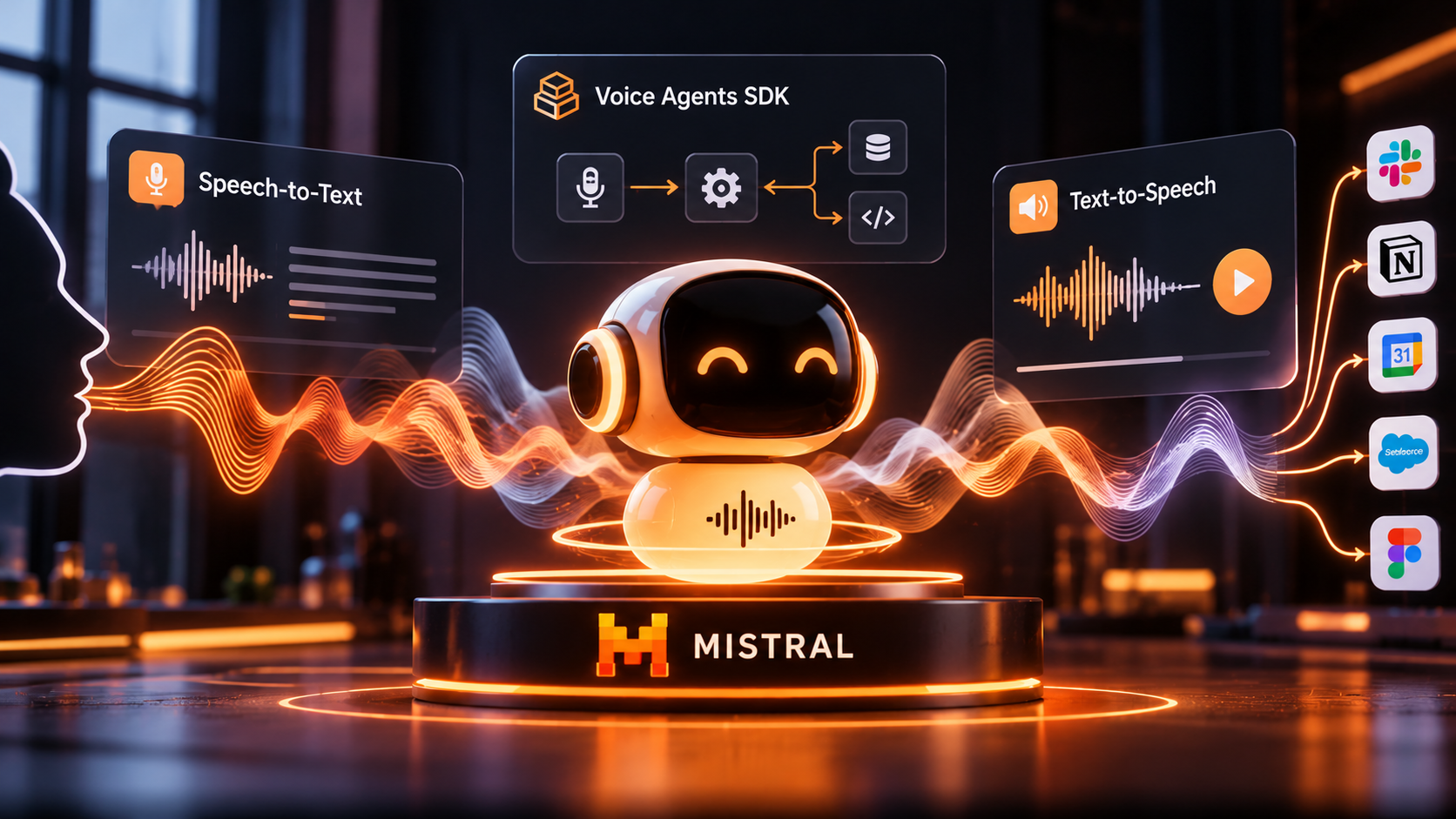

Mistral AI has launched Voxtral 3, a package that combines speech-to-text and text-to-speech models with a LiveKit-based SDK for building real-time voice agents. Mistral describes it as a streaming system that can listen to speech, generate a model response, call tools, and return spoken output during a live conversation.
The release goes beyond a standalone speech model. Mistral’s documentation says its Voice Agents SDK manages transcription, model responses, spoken output, and tool calls for two-way voice conversations. A team building a phone assistant, support bot, or spoken internal tool can start from that framework instead of wiring together audio transport, transcription, a language model, speech synthesis, and external actions on its own. The Decoder reports the same combination: speech-to-text, text-to-speech, and a LiveKit-based SDK for real-time agents.
Why LiveKit matters. Mistral says the SDK is built on LiveKit, a framework for real-time audio and video communication. That’s the layer that handles a live, interruptible conversation, as opposed to a one-off transcription or a generated audio file. The material supports the claim that these pieces are integrated. It doesn’t show that the stack is faster, cheaper, more reliable, or higher quality than combining other speech and agent services.
Languages. Mistral says Voxtral 3 supports more than 50 languages. Neither the announcement nor the documentation gives per-language accuracy, dialect coverage, a benchmark method, or evidence that quality is consistent across all of them. Read it as a coverage claim, not a quality guarantee.
Tool calling raises the stakes. Mistral says agents built with Voxtral 3 can use tool calling to interact with external systems mid-conversation, and the SDK documents tool calls as part of what it manages. That’s what could make a voice agent more than a question-answerer: retrieving information or triggering a workflow, using whatever tools a developer provides. But the cited materials don’t specify supported tool protocols, authorization controls, confirmation steps for consequential actions, or safeguards against a mishearing causing an unintended call. Voice adds risks typed systems don’t have. A word can be misheard, a speaker misidentified, or a spoken reply can obscure that an action is about to happen. No independent evaluation of those risks is published.
Deployment. Mistral says Voxtral 3 is available through its API, can be deployed on customer infrastructure, and offers EU-hosted API availability. That could matter for buyers with data-location or audio-handling requirements. The announcement doesn’t give retention terms, model licensing, self-hosting prerequisites, feature parity between deployment modes, or which regions support every capability. Anyone with regulated or sensitive voice workloads will need to confirm those details in the technical and commercial documentation.
Bottom line: Voxtral 3 is Mistral’s attempt to offer a complete developer surface for real-time voice agents, not just another speech model family. The announcement and documentation back up the integration claim. What’s unproven is the part that decides production value: whether bundling these pieces delivers better latency, quality, reliability, governance, or cost than assembling comparable services independently. Pair this with ElevenLabs’ v4 and Turbo launch if you want a voice-agent comparison piece, since the two take different approaches to the same market.