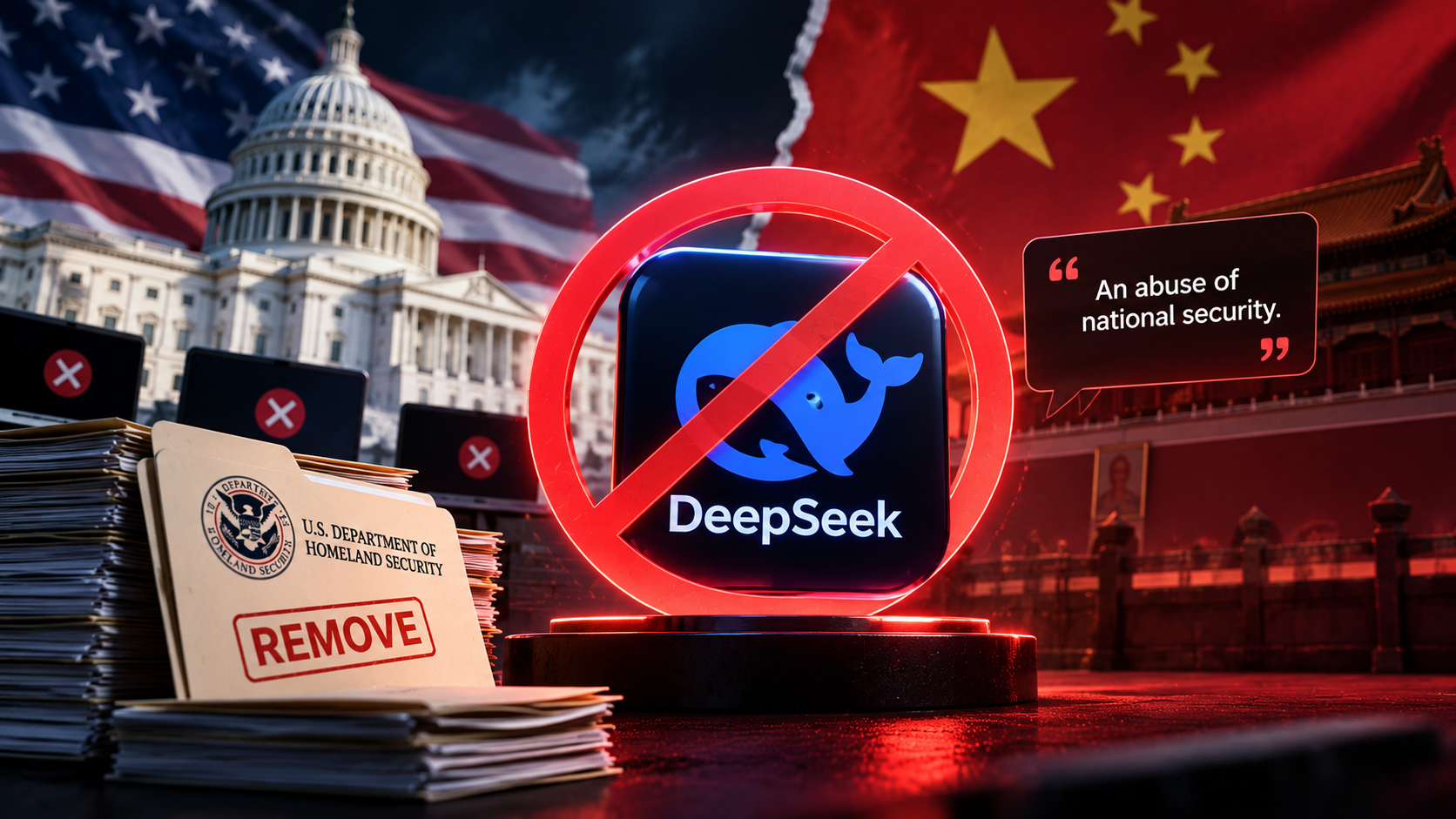

The US has ordered civilian executive-branch agencies to remove DeepSeek products from their IT systems and stop buying them, according to an October 20 Department of Homeland Security order published through the Federal Register. The action covers DeepSeek products, products from its affiliates, and third-party products based on DeepSeek.
China’s Foreign Ministry condemned the decision the same day. At a regular press conference, spokesperson Mao Ning said China opposes what she described as an excessive use of national-security arguments and the politicization of technology and trade issues. The Associated Press also reported that China rejected the US security rationale and said it would protect the legitimate interests of Chinese companies.
What the order does, and doesn’t, cover. The immediate consequence is a restriction on federal civilian IT and procurement, not a general US ban on DeepSeek. The notice applies to federal civilian executive-branch systems. It requires agencies to exclude covered products from procurement and remove them from their IT environments. It doesn’t establish a ban on DeepSeek in private-sector systems, consumer devices, state governments, academic research, or non-US government networks.
The definition is broad. Because the order includes affiliate products and third-party products based on DeepSeek, it reaches past a single branded app. For government IT teams, that creates an inventory problem: a product could be covered even if it isn’t marketed as “DeepSeek.” The notice, as described, doesn’t publish a product-by-product list or identify a specific technical vulnerability.
Two positions, neither resolved. The Federal Register action shows a US policy decision and its required scope. It’s not a public technical audit of DeepSeek’s products. China’s statement is a government position, not an independent assessment of the order’s security basis. The material available here doesn’t settle the competing claims about the underlying risk, and it doesn’t publish evidence on data handling, model behavior, or software security that would let outsiders judge them.
What it means in practice. For developers and vendors serving federal civilian agencies, the near-term issue is compliance: DeepSeek products and covered derivatives now fall under the removal and procurement restrictions. If you sell software that wraps or builds on DeepSeek models, it’s worth checking whether your product counts as covered. More broadly, the order is another reminder that procurement rules can shape which AI tools get deployed as much as capability does.
Bottom line: The record supports a firm conclusion on the policy: civilian federal agencies have been told to exclude and remove covered DeepSeek products. It doesn’t support a broader conclusion that a technical flaw in DeepSeek has been publicly substantiated, and it doesn’t show that China’s accusation of political motivation has been proven. What to watch next is whether DHS publishes more detail on the security basis, and how agencies and vendors interpret “based on DeepSeek.”