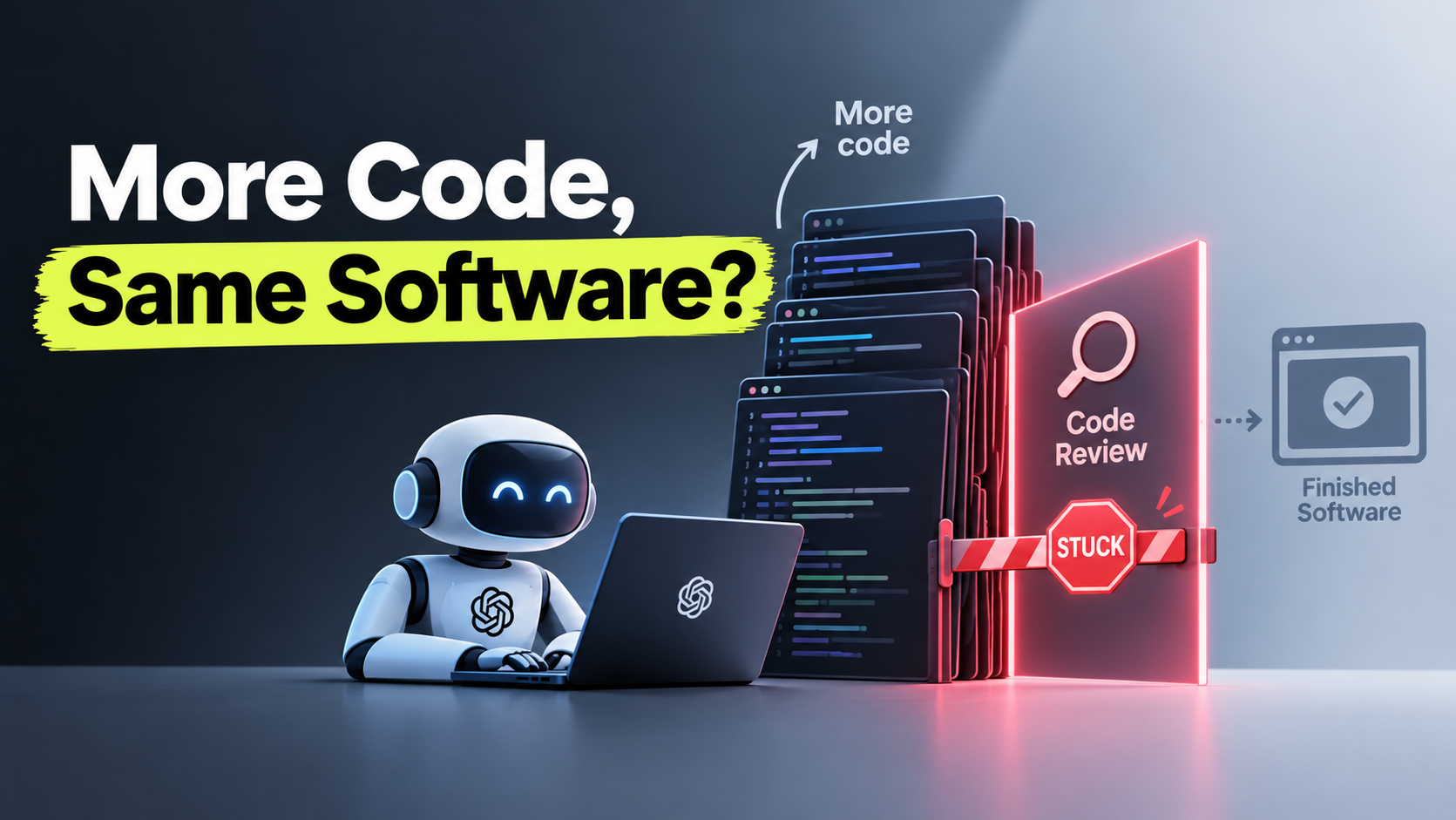

A study of 655 firms by Fiona Chen and James Stratton, Artificial Intelligence in the Firm: Bottlenecks in Software Production, finds that adopting AI can substantially increase code output without a proportional increase in finished software. The authors report that code review becomes a limiting factor as AI raises the volume of code. Software production depends on evaluating, testing, approving and integrating changes as well as writing them. Ars Technica's coverage adds that AI-agent adoption was associated with more code activity, longer review time and more requested changes, while issue-resolution output showed no statistically significant increase.
This matters for teams that judge AI coding tools by commits or pull requests. Those numbers are easy to measure and easy to improve, but in this dataset they overstated progress toward completed work. The bottleneck is confidence: someone or something has to establish that a change works, is safe to deploy and doesn't break adjacent systems. When changes multiply, that validation can become the binding constraint even if writing gets cheaper, and the gain piles up as a larger queue instead of a faster release cycle.
Anthropic describes the same pressure in its own engineering. In a Claude Code post, the company says its monorepo went from roughly 2,500 daily changes to more than 30,000. It says it responds with agent-assisted review, automated tests, security checks, risk-based human approval and rollback. That is one AI company's account of how it handles volume. It isn't independent proof that the workflow improves quality or can be copied elsewhere, and the change counts haven't been independently verified.
The evidence has limits. It doesn't show that AI-written code is poor, that every firm sees the same result, or that AI lowers developer productivity overall. It shows that, in this dataset, faster code production didn't translate proportionally into finished software. For engineering leaders, the practical step is to pair creation metrics with delivery evidence: review time, requested revisions, test results, deployment outcomes, rollback frequency and the rate at which user-facing work gets completed. The study doesn't say which of those measures is best or quantify the return from any tool.