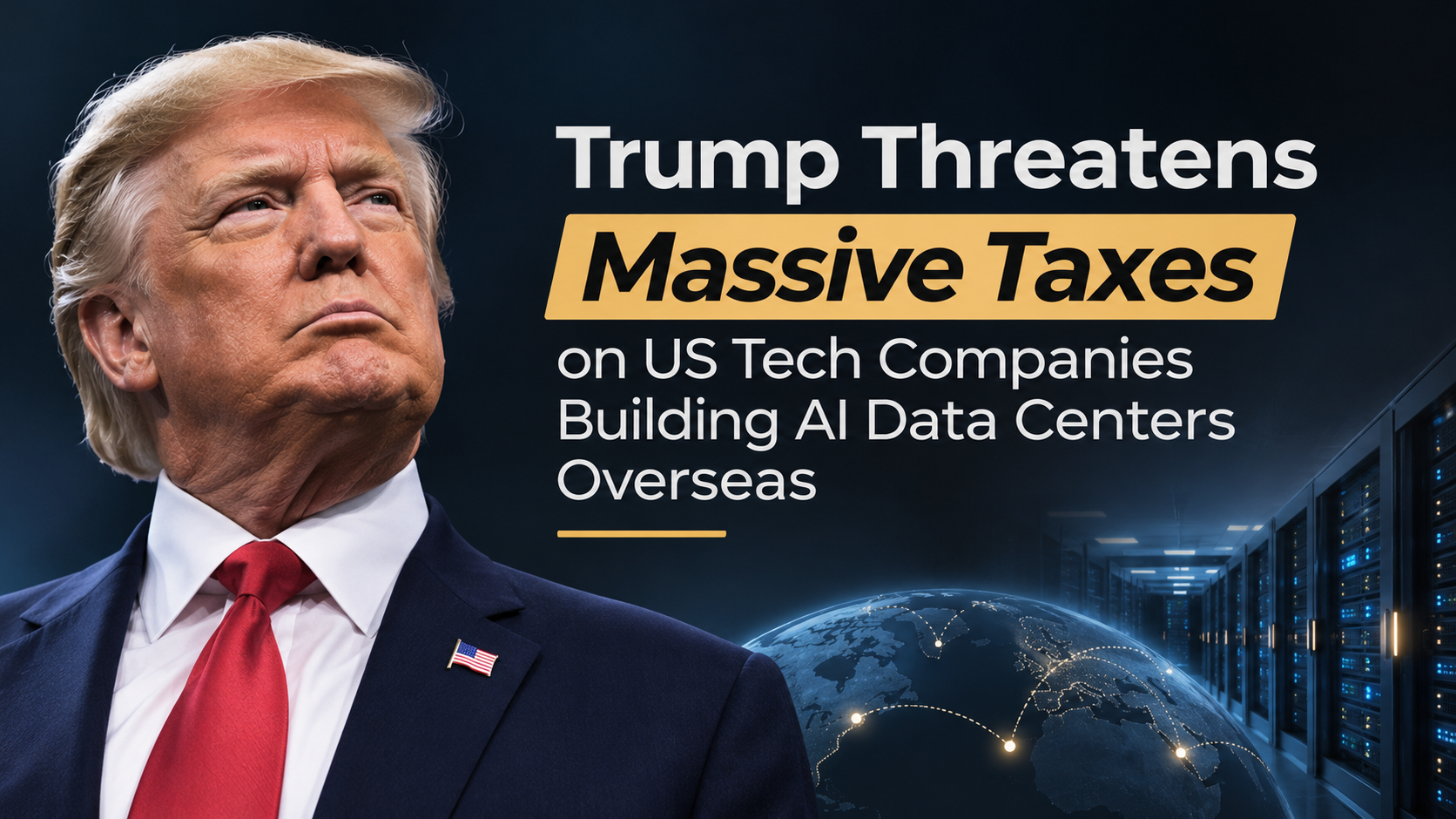

President Donald Trump has threatened to impose a “tremendous tax” on American companies that build artificial intelligence data centers outside the United States. The move reflects his push to keep critical AI infrastructure at home and maintain America's competitive advantage over China.
Speaking at a White House news conference on November 20, following his trip to Asia, Trump said the US would not allow American companies to move their data center construction overseas without facing significant financial penalties.
Trump argued that expanding AI infrastructure within the country is essential to maintaining America's leadership in advanced computing. He also warned that allowing companies to build facilities abroad could give China greater access to computing resources and weaken the US position in the global AI race.
However, the proposal raises important questions for major technology companies. Businesses such as Google, Amazon, Microsoft, and Oracle operate data centers across multiple countries to support cloud computing, AI services, and international customers.
Building facilities closer to users helps companies reduce processing delays, improve reliability, and comply with local data protection and storage requirements. A potential tax on overseas construction could therefore increase operating costs and complicate global expansion plans.
Trump's announcement also comes as data center construction faces growing opposition across the United States. Communities have raised concerns about rising electricity bills, heavy power consumption, water usage, and environmental impact. Many residents are questioning whether the benefits of these facilities outweigh the costs.
The president encouraged local communities to negotiate directly with technology companies, suggesting they seek financial support, lower utility bills, tax benefits, and other investments in return for allowing data centers to be built in their areas.
For now, the proposed tax remains uncertain. Trump has not specified the tax rate, which companies would be affected, or how the measure would be enforced. He also acknowledged that he had not yet discussed the proposal with his administration.
If implemented, the policy could reshape how American technology companies plan their global AI infrastructure investments, potentially affecting the future expansion of data centers in markets such as India, Europe, and Southeast Asia.