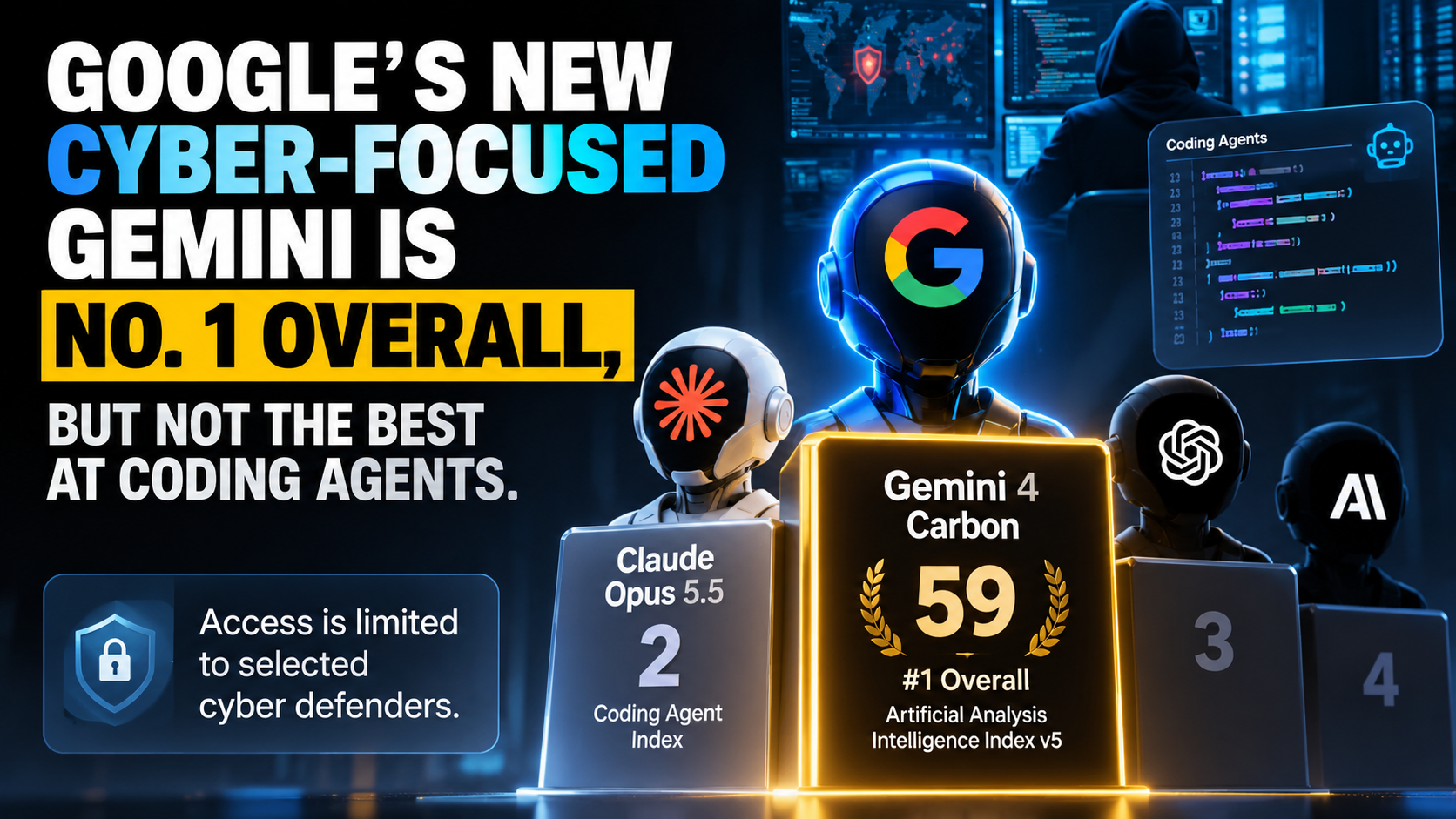

Google has introduced Gemini 4 Carbon, a model it says is designed for long-horizon agentic coding and cybersecurity defence. The launch comes with a split in third-party results. Artificial Analysis ranks Carbon first on its Intelligence Index v5, with a score of 59, but second on its Coding Agent Index, behind Claude Opus 5.5.
Why the split matters. Artificial Analysis measures the two categories separately. The Intelligence Index is a composite across many kinds of tasks, while the Coding Agent Index tests the specialized job of working as a coding agent. Carbon’s overall win doesn’t carry over to the category Google emphasizes most. Put simply, “best overall” and “best at coding agents” are different questions, and this model answers them differently.
Access is restricted. Google says Carbon follows Gemini 4 Argon by two weeks and that initial access will go to a subset of cyber defenders through its Fairwind Program, not a broad public release. Reuters likewise reports that access is initially limited to selected cybersecurity defenders, and that Google is focusing the model’s security use on vulnerability discovery, exploitation, and patching.
Those capabilities cut both ways. A model that helps find flaws or reason about exploitation can help defenders, but it also needs careful access controls. Google’s announcement says who gets early access. It doesn’t publish the selection criteria, the safeguards used in the program, or how the rollout will be evaluated. There’s also no public timetable for wider availability.
What the rankings don’t show. Neither Google, Artificial Analysis, nor Reuters establishes how Carbon performs inside real security teams or over long real-world software projects. The sources don’t say how often it successfully finds, exploits, or helps patch vulnerabilities, how it compares with human researchers, or what its failure rates are in practice. A benchmark lead is an outside measurement, not production validation.
Bottom line: Carbon holds the top spot on Artificial Analysis’ overall index and has a clear cybersecurity focus in Google’s launch strategy. But its second-place coding-agent ranking, limited availability, and lack of published real-world results mean its biggest claims still have to be tested outside the first group of defenders.