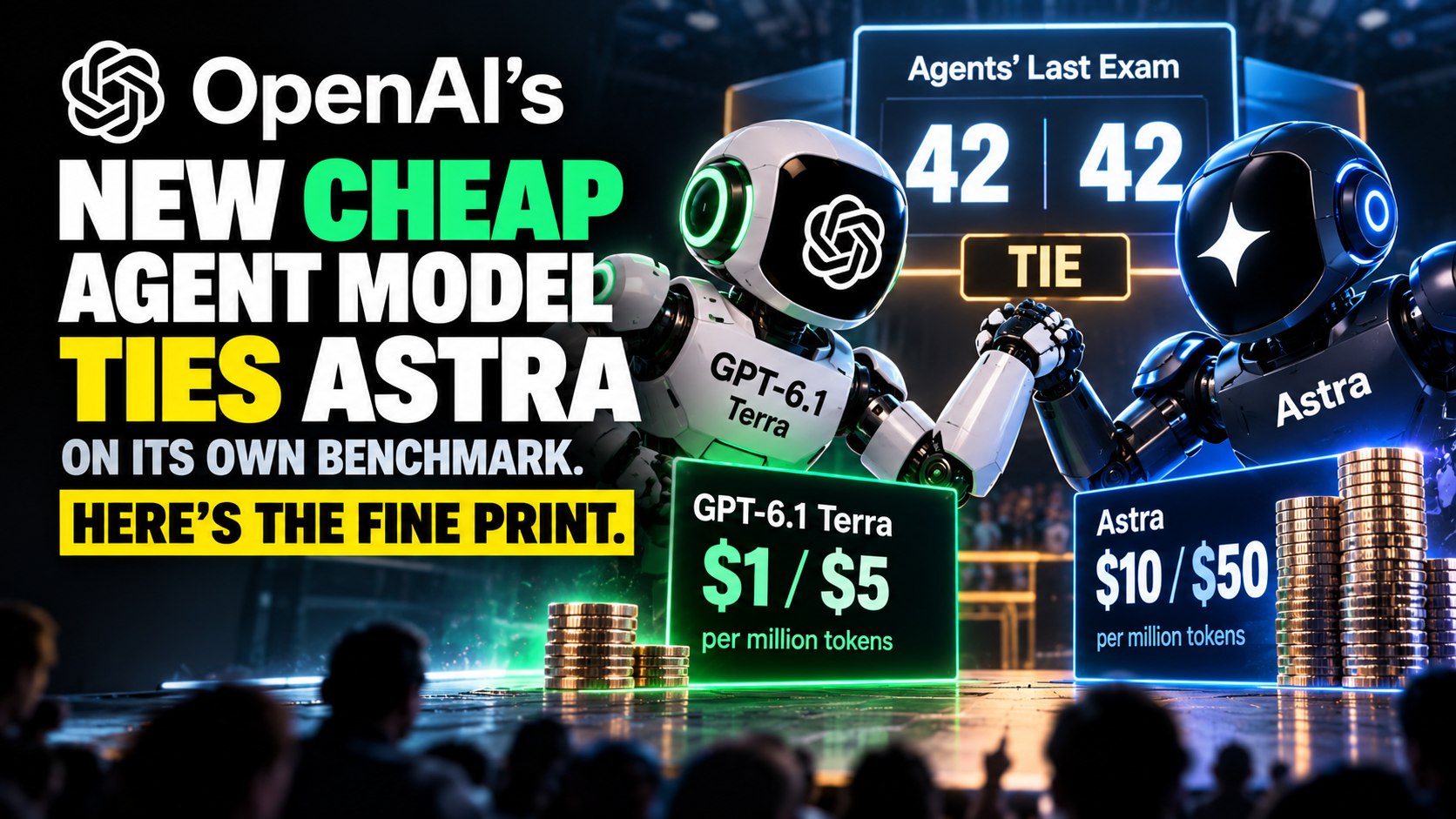

OpenAI has introduced GPT-6.1 Terra, a lower-cost, faster model for agent workloads, and says it is not a replacement for GPT-6 Astra. It launched Monday, October 26, priced at $1 per million input tokens, $0.05 per million cached input tokens, and $5 per million output tokens, which OpenAI says is 50% below both GPT-5.6 Terra and GPT-6.1 Sol.
technology
ghacks
The headline claim. OpenAI says Terra reached the same result as Astra on Agents’ Last Exam, a benchmark of professional computer-use tasks, at one-tenth of Astra’s per-token price. At medium effort both score 57.6%, at an estimated $0.29 per task versus $4.82 for Astra. At maximum effort, Terra scores 60.0% at $1.01 per task. OpenAI also says Terra completes tasks over three times faster than Astra and Sol. At launch, every benchmark figure came from OpenAI’s own announcement.
GPT-6.1 Terra: Benchmarks, Pricing & Model Comparisons
+2
OpenAI draws its own boundary. The company says GPT-6.1 Sol and Astra remain better options for its hardest coding tasks. So the announcement isn’t evidence that the cheaper model has displaced the top tier on demanding software work. It’s OpenAI saying it can offer a much cheaper option for agent work without giving up its cited benchmark result.
Keep the two price comparisons apart. The one-tenth figure compares Terra with Astra’s per-token price, while the 50% reduction compares it with GPT-5.6 Terra and GPT-6.1 Sol. Per-token price and cost per task are also different measures. The $0.29 versus $4.82 figure is an estimated cost per task on one benchmark, which depends on how many tokens each model uses.
ghacks
The pricing fine print. Terra has a context window of about 1.05 million tokens. The headline rates apply to prompts up to 272,000 input tokens, and larger prompts move to long-context pricing. Cache writes are charged separately. The $1 rate shouldn’t be applied to every workload without checking prompt size.
OpenAI Launches GPT-6.1 Terra With $1/M Input Pricing
+2
The Claude comparison. OpenAI also compares Terra with Anthropic’s Claude Opus 5.5 at maximum effort, saying Terra uses more than three times fewer tokens, costs about a quarter as much per token, and works out to roughly nine times lower cost per task on that benchmark. That’s OpenAI’s comparison on OpenAI’s chosen test, not an independent result.
diyai
What isn’t established. The materials don’t include independent replication of Agents’ Last Exam, a breakdown of its tasks, or results from outside evaluators. Matching Astra on one agent benchmark doesn’t show equivalent behavior on production codebases, long-running computer-use jobs, third-party tool failures, or security-sensitive work. The speed claim also describes model speed. In a real product, browser automation, API latency, queues, retries, and human approval steps can dominate elapsed time.
Bottom line: Terra is worth testing when agent throughput and token spend are the constraints, especially for visual-reasoning and computer-use work. OpenAI’s own advice to keep Sol and Astra for the hardest coding is just as relevant. The public numbers are a reason to run workload-specific tests, not a substitute for them.