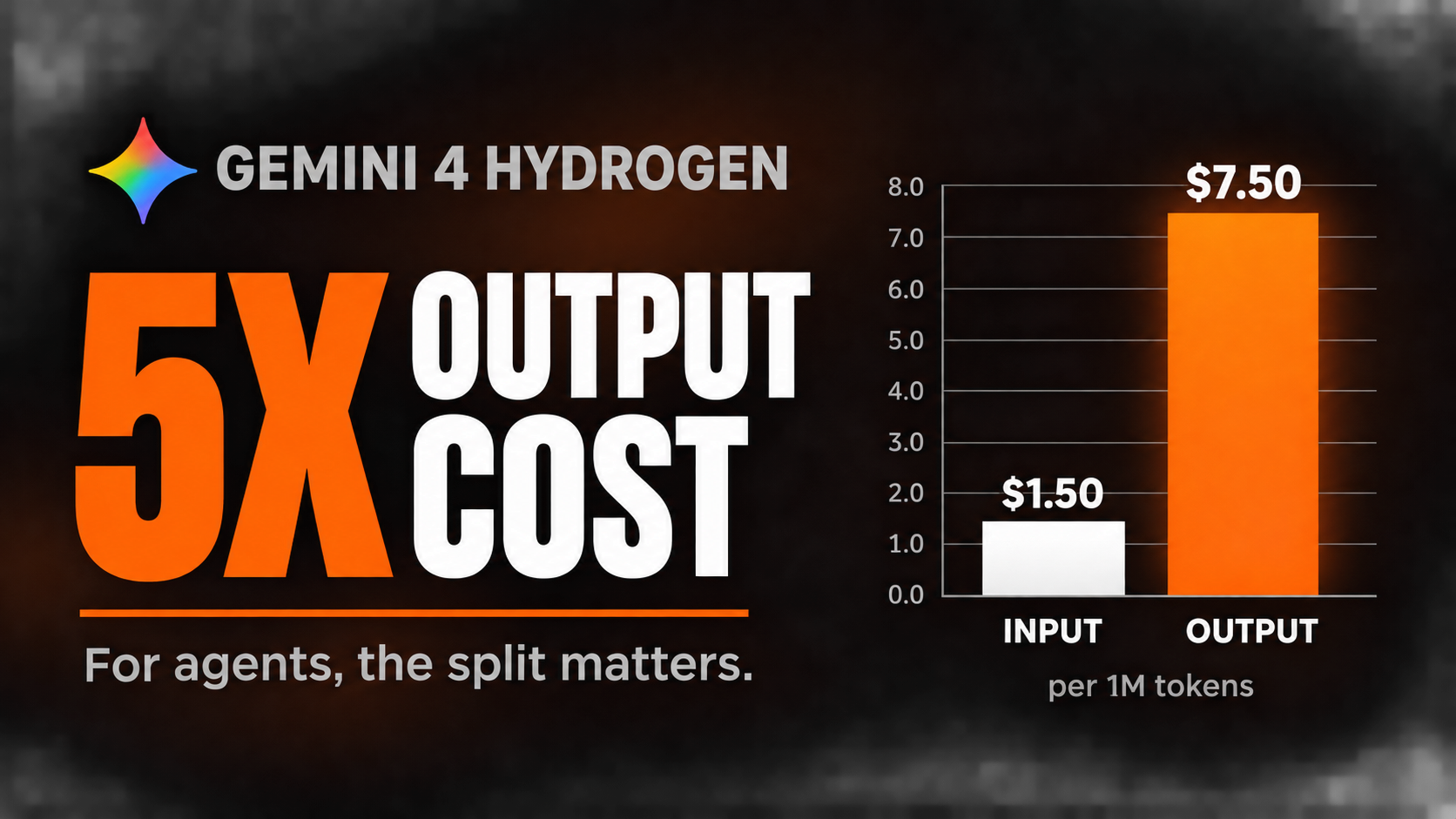

Google lists Gemini 4 Hydrogen output tokens at $7.50 per million, against $1.50 per million for input. That is a fivefold difference, and developers need to account for it when estimating the cost of coding and agentic workloads. Google introduced Hydrogen for rapid coding and agentic workflows and says it supports a one-million-token context window. That combination suits workflows that send a lot of code, documentation, instructions or task history as input and then generate code and other responses as output.
The split makes the bill depend on the mix. Generated tokens carry the higher rate, so the balance between prompt size and response size matters as much as either price. As an illustration, using only the published rates: a request with 800,000 input tokens and 20,000 output tokens would cost about $1.20 for input and $0.15 for output. Large prompts can dominate the cost even at the lower rate. A workload that generates long responses from short prompts leans the other way. Neither example is a Google figure, so test your own ratio.
Google DeepMind has also released a model card covering Hydrogen's intended uses, evaluations, limitations, and safety and security mitigations. An accompanying evaluation report covers benchmarks across agentic coding, knowledge work, computer use, multimodal understanding, science, mathematics and reasoning. Those documents show Google has published safety, limitation and evaluation material. The information available here doesn't include benchmark scores, baselines, test configurations or task-level results. It doesn't establish how Hydrogen compares with other models, how reliably it handles real software tasks, or how performance changes near the context limit.
What's established is narrow: a model aimed at coding and agents, a one-million-token context window, and separate prices for input and output tokens. Whether it's worth the price depends on testing against your own repositories, tools, permissions and expected failure modes. Measure cost per completed task, not per token.