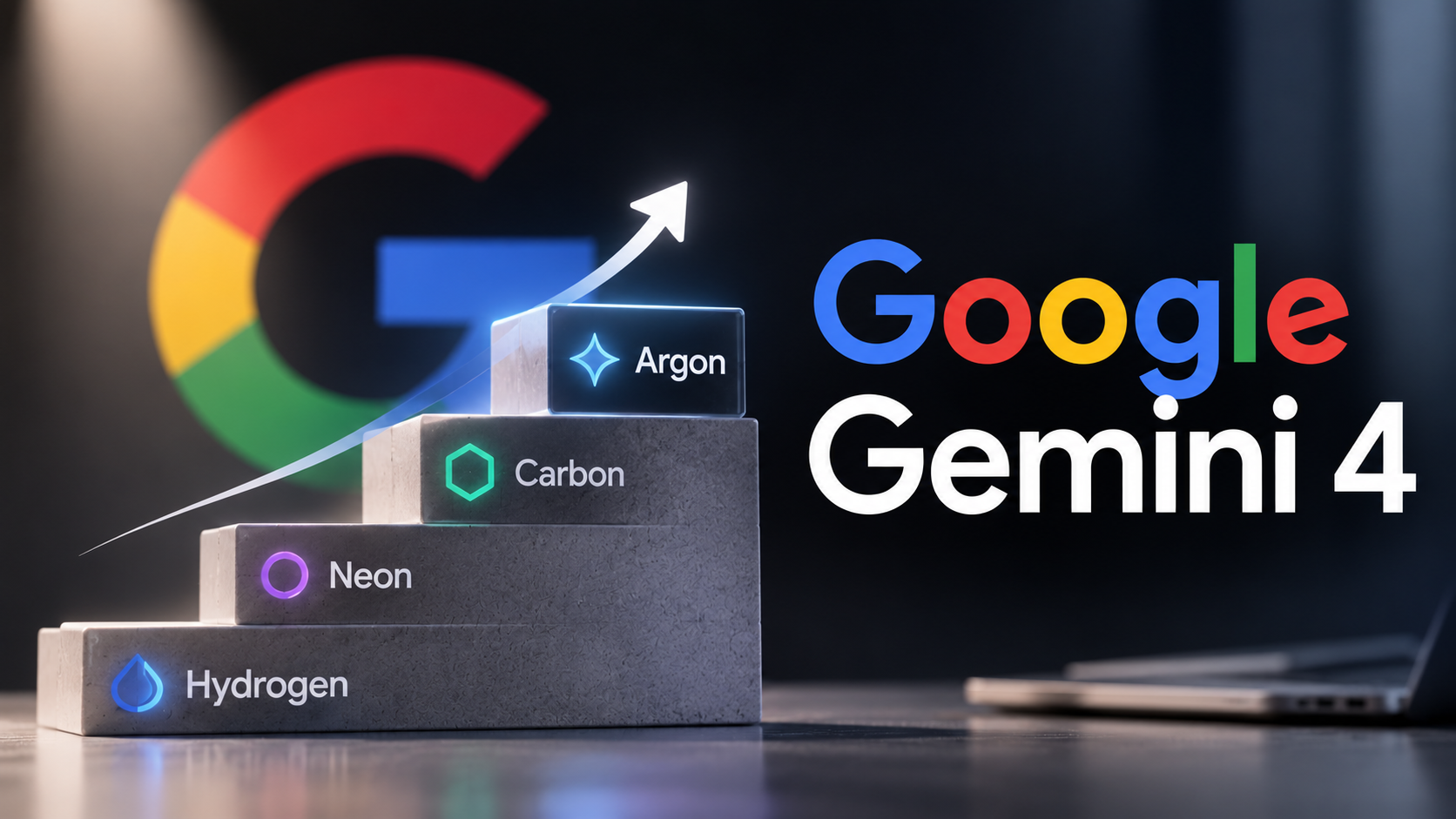

Google's Gemini 4 is now a family of four models sorted by role and price. Gemini 4 Hydrogen, announced November 12, is positioned as the fast, low-cost option for coding and agentic workflows. Gemini 4 Neon, announced November 18, sits between Hydrogen and Carbon and is rolling out through the paid Gemini API in AI Studio, Gemini for business, Antigravity and the Gemini app for AI Pro and Ultra subscribers. Gemini 4 Carbon and Gemini 4 Argon are cast as models for longer-horizon work. Argon went to selected cybersecurity partners on September 30, per Axios, and became broadly available on October 13. The news isn't a leap in coding performance. It's Google segmenting one product line by operational role, so that an agent could use a cheap model for narrow execution steps and a costlier one for planning or sustained work.
The prices are the useful part, where they exist. Google lists Hydrogen at $1.50 per million input tokens and $7.50 per million output, and Neon at $3 and $15. Carbon is paid-API and enterprise only with no public price in the materials, and Argon's terms aren't given here either. That's a ladder with its top rungs missing. Both Neon and Hydrogen carry a one-million-token context window, which is relevant for large repositories and long histories, though context capacity alone doesn't show a model can reason accurately across all of it.
The benchmark claim is specific and narrower than it sounds. Google says Neon scores 61 on Artificial Analysis's Intelligence Index at its "xhigh" thinking setting, and Artificial Analysis reports the same figure. That puts Neon one point above Carbon and third overall, behind GPT-6.2 Astra at 62 and Claude Fable 5.2 at 65. So the independent evidence supports an upgrade inside the Gemini line, not leadership over the field. It also says nothing about a specific engineering task, a long-running agent workflow, production latency or reliability, and it doesn't establish whether the named competitors were run with equivalent tool access and settings.
For teams building agents, the tiering is a plausible way to cut cost, since a job often breaks into many calls for planning, generation, tool use, verification and repair. But Google hasn't published which coding tasks Hydrogen handles reliably, where it should hand off to Neon or Carbon, or what the savings are in production. A "lower-cost" claim only means something once you compare per-token prices against throughput, context limits and the number of retries real tasks need. There's no independent benchmark suite, latency test or case study for Hydrogen in the available record, and no measured boundary showing where a cheap call becomes less reliable than an expensive one. Treat the lineup as a pricing menu to test against your own workloads, not as a ranking.