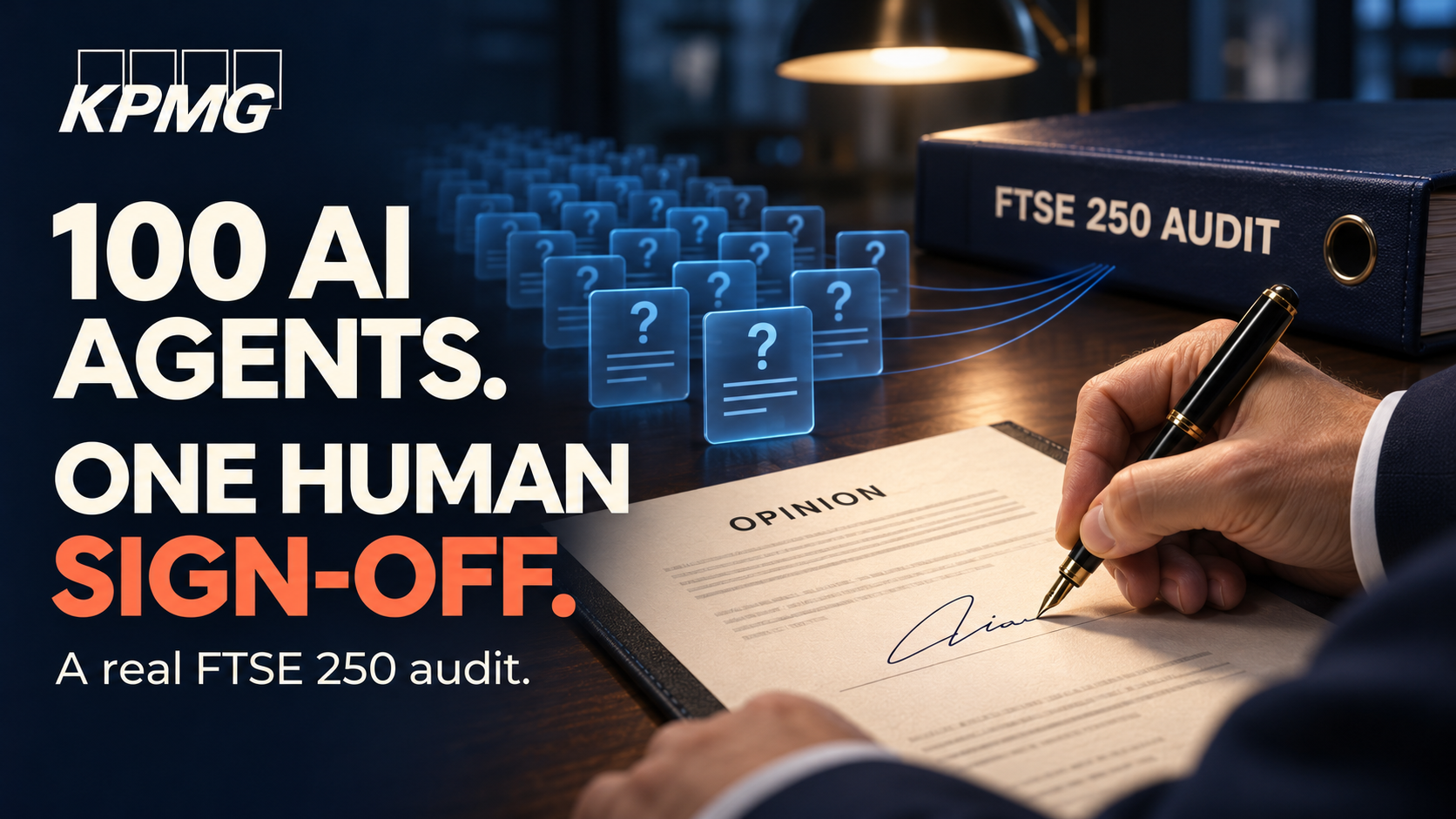

KPMG deployed more than 100 AI agents alongside a conventional audit of an unnamed FTSE 250 company, in an experiment it calls Project Exponential, according to the Financial Times and The Decoder. The agents did not do the audit. The Decoder reports that the formal audit opinion continued to rest on the conventional audit, with humans reviewing the agents' work. That makes the pilot a parallel test of how broadly AI can investigate audit material, not a case of a listed company's accounts being approved by software.
The headline observation comes from KPMG UK head of audit Cath Burnet, who told the Financial Times that the system sometimes went deeper than the regular audit team and asked "better questions." That is a qualitative judgement from the firm running the pilot. The FT did not establish that the agents were more accurate overall, found more material issues or changed the final conclusion. The available accounts also don't say which evidence the agents examined, how the work was divided, how outputs were measured, how often their questions led to findings that mattered, or what the system cost. There's no error rate and no comparison with a human-only process.
One documented failure shows why the human review wasn't nominal. The Irish Times, republishing FT reporting, said a human had to correct a regulatory-matching failure during the pilot. Neither account says how often comparable failures occurred or whether the mistake would have affected the outcome. But asking a useful question is not the same as producing sufficient audit evidence. In an audit, human review isn't just a sign-off step. It's part of deciding whether an AI-generated line of inquiry is valid at all, and in this pilot the humans both reviewed the work and fixed at least one error.
The result is still substantive. KPMG has shown that a large group of agents can take part in a real audit workflow and sometimes surface questions its audit leadership found valuable. It has not shown that agents can reach a reliable audit conclusion on their own, take responsibility for an opinion, or consistently outperform the conventional team. The credible near-term use is a wider investigative layer: software that helps professionals inspect, connect and challenge information before people decide what the evidence means. The pilot's own design, a conventional opinion, human review and a documented correction, is the clearest sign that KPMG hasn't crossed into autonomous assurance.