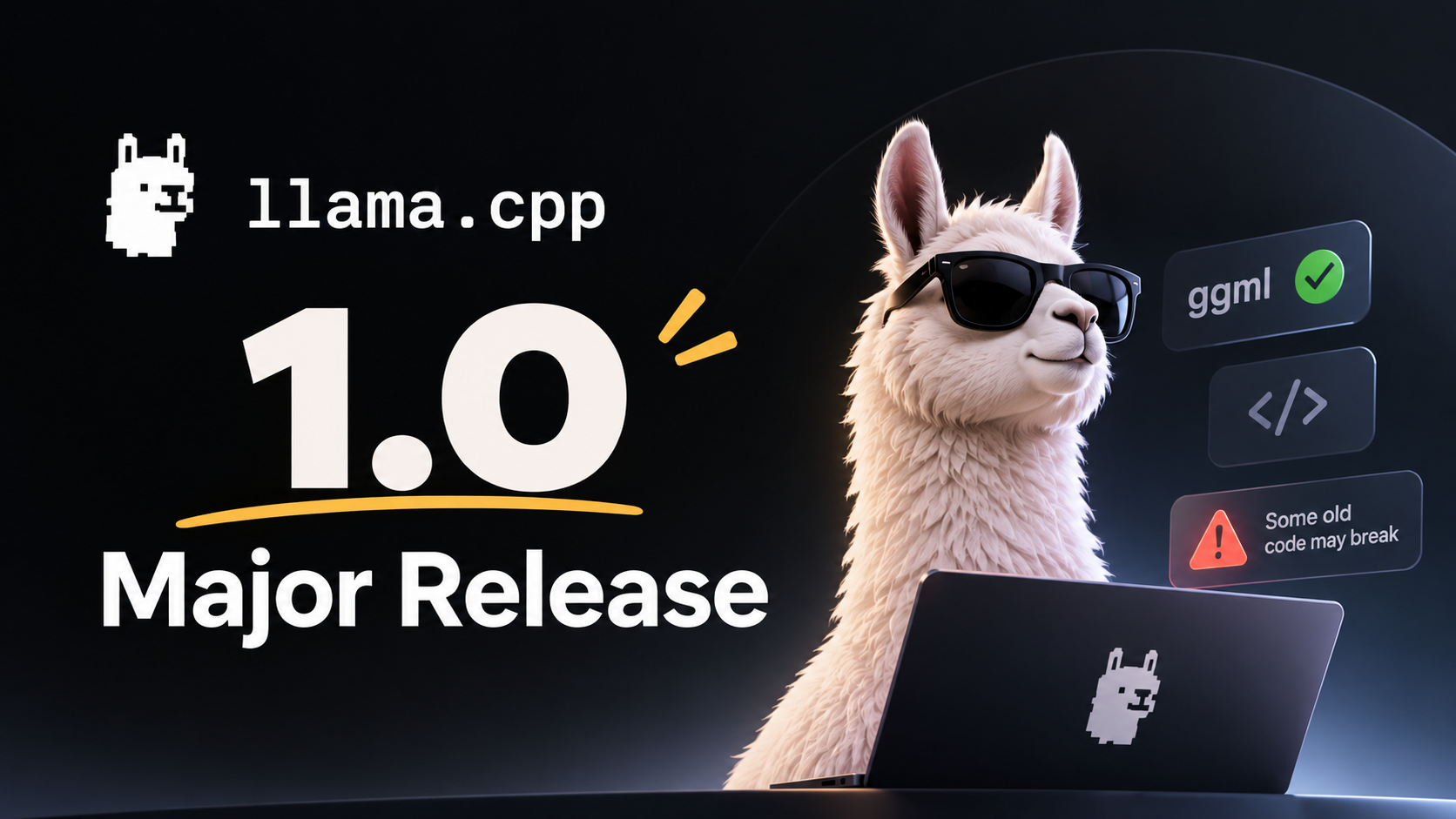

llama.cpp and its underlying tensor library ggml reached version 1.0.0 on November 13, after about three and a half years of build-numbered releases. The ggml-org team at Hugging Face says both libraries now follow semantic versioning, with a major version bump marking a breaking change to the public C API, and in the maintainers’ words, API and ABI incompatibilities from now on. The news is less about a performance breakthrough than about making releases predictable for the software built on top of the runtime.
What the promise means. A MAJOR bump means a breaking change to the public C API in the include folder, MINOR covers backward-compatible features, backend updates, and new model support, and PATCH is for bug fixes with no API change. For anyone with a program linked against llama.cpp, the version number now signals whether an update might break something. It doesn’t freeze the interface, though. The API will still change, but the changes will be announced.
The first 1.0 release already breaks some code. The cleanup happened before the promise took effect. The release removed 35 deprecated functions from the public API, moved the NextN API used for speculative decoding from llama-ext.h into the public llama.h, and renamed llama_set_embd_state_src to llama_set_ctx_state_src. If your code used any of the deprecated calls, it needs updating before you move to 1.0. That answers the open question about which interfaces changed, at least for the public C API.
Which tags to track. The project’s release notes say vX.Y.Z tags mark stable versions with a slower cadence, recommended for downstream distribution and casual users, while b[NUM] tags are the faster bleeding-edge builds for developers. If you ship software that bundles llama.cpp, the stable tags are what the maintainers recommend.
What else shipped. The project now supports more than 150 model architectures. The release also adds an FP8 KV cache and an MoE expert cache for local models. The announcement also links desktop apps for macOS and Windows 11. Your supplied material describes a native macOS menu-bar app built on llama.cpp with a stated 4 MB size, and gives much less detail on the Windows app, so don’t assume the two match.
What 1.0 doesn’t show. The release materials don’t provide benchmarks for tokens per second, memory use, startup time, model quality, or server throughput, and they don’t show that 1.0 makes any deployment faster or more reliable. A 1.0 label is a release-management commitment, not a guarantee that upgrades will be frictionless.
What to do. Read the official v1.0.0 release notes, map them to the APIs and server endpoints your application uses, and test the upgrade in the environments where it will run. Treat version changes as dependency-management events.
Bottom line: llama.cpp 1.0 matters because a runtime that much of the local-AI ecosystem builds on has committed to telling developers when it will break their code. The first release under that promise broke some, so expect a small migration this time and more predictable upgrades afterward.