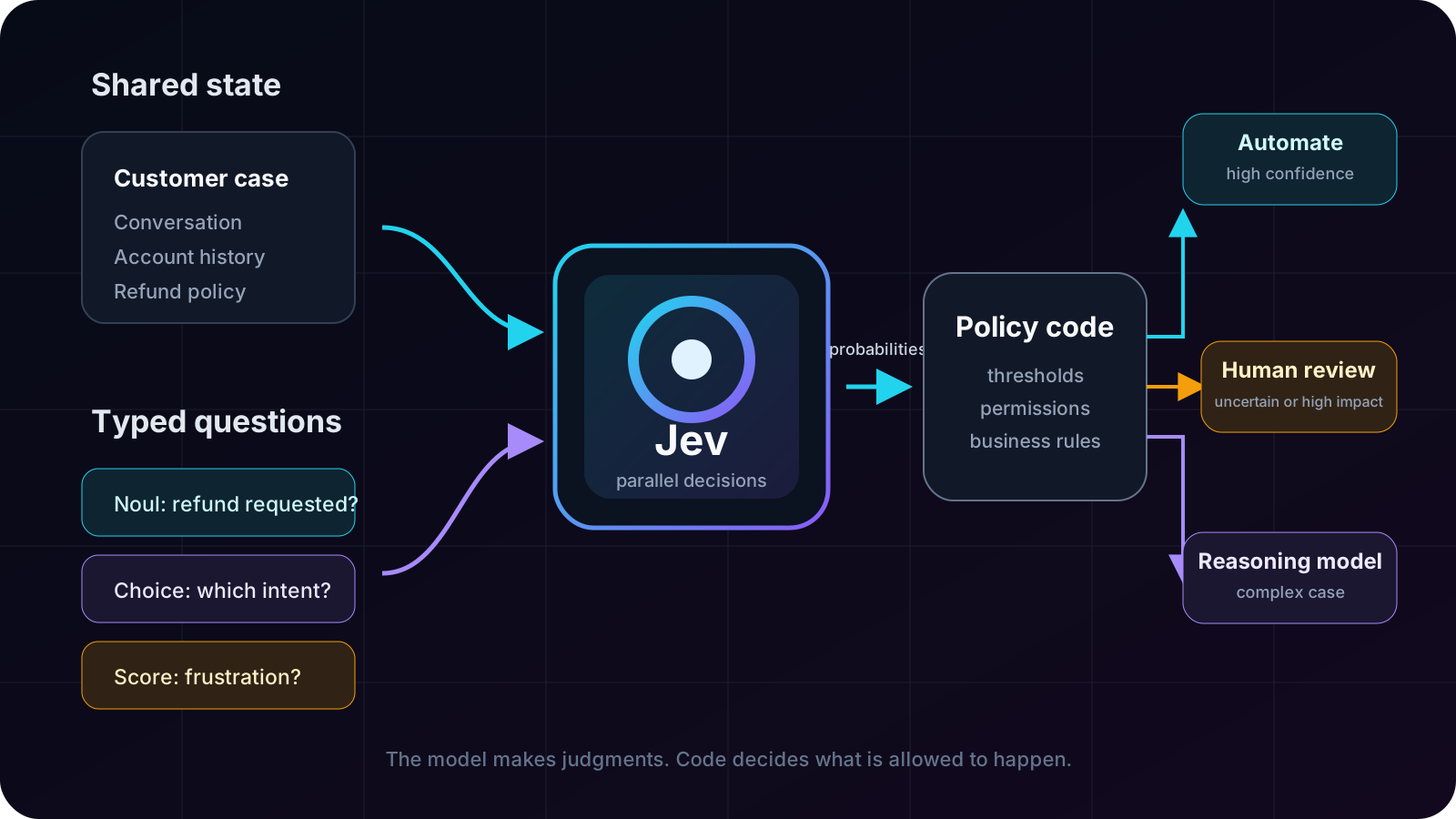
Jev takes a different approach to AI: less conversation, more decisions — built for the agents powering tomorrow’s software.
Jev AI: TypeSafe’s New System One Model Built to Decide, Not Chat
What if the next big AI model isn't designed to write more — but to decide faster?
That's the idea behind Jev, a new AI model from TypeSafe AI that takes a radically different approach to software automation.
Instead of generating paragraphs of text like ChatGPT, Claude, or Gemini, Jev is designed to make fast, structured decisions that software can use directly. TypeSafe calls this new category a “System One Model.”
And that could make Jev particularly interesting for AI agents, automation, routing, classification, risk scoring, and software decision-making.
Jev is TypeSafe AI's first System One Model.
Rather than producing free-form text token by token, Jev takes a piece of information — such as a support ticket, application state, log, document, or other software data — and answers predefined questions with structured outputs.
Those outputs can include things such as:
Choices — select an option from predefined possibilities
Scores — evaluate something against a defined scale
Boolean decisions — determine whether something is true or false
Probabilities and confidence — indicate how certain the model is about its decision
The key idea is simple:
Don't generate text if software only needs a decision.
This is where Jev AI differs from traditional large language models.
A conventional LLM generates an answer one token at a time. Your application then has to interpret, parse, validate, and act on that response.
Jev is designed to skip much of that process.
TypeSafe says its model evaluates declared questions in parallel and returns typed decisions with probabilities directly.
That makes Jev less like a chatbot and more like a decision engine for software.
“System One Model” is the term TypeSafe uses for this new approach to AI.
The concept is inspired by the distinction between fast, intuitive System 1 thinking and slower, deliberate System 2thinking.
TypeSafe's argument is that not every software decision requires a large reasoning model.
Sometimes an application simply needs to know:
Should I retry?
Which tool should I use?
Is this request risky?
Which category does this belong to?
Should this AI agent continue or stop?
For these types of bounded decisions, a fast decision model could be more practical than generating a full natural-language response.
AI agents increasingly need to make small decisions throughout a workflow.
An agent might need to decide whether to:
call another tool
retry an operation
escalate to a human
stop an action
select another sub-agent
classify a request
score risk
evaluate whether an output is acceptable
Using a large language model for every small decision can add latency and cost.
Jev is designed specifically for this type of workflow.
Vercel, which made Jev available through its AI Gateway, highlights use cases including choosing the next tool or sub-agent, deciding whether an agent should continue or stop, and scoring urgency or risk.
One of the biggest parts of the Jev announcement is its focus on speed and efficiency.
TypeSafe reports that Jev was up to 193.6× faster and 444.6× cheaper than the LLMs used in its workflow evaluations. These are TypeSafe's own reported benchmark results, so they should be treated as vendor claims rather than independent benchmark results.
The reason for the potential efficiency difference is the architecture.
Instead of generating a long sequence of tokens, Jev is designed to evaluate multiple structured questions in parallel and return the decisions directly.
That makes the model particularly relevant to high-volume AI inference and automation workflows where thousands or millions of small decisions may need to happen quickly.
This is one of the more interesting claims surrounding Jev AI.
Because Jev's outputs are constrained to the types and choices defined by the developer, TypeSafe says the model cannot produce an invalid free-form answer outside the defined schema.
But there's an important distinction.
Not generating an invalid format doesn't mean every decision is correct.
Jev can still make the wrong choice within the options provided. The value of the model therefore depends on the quality of its decision-making and calibration.
Jev isn't necessarily trying to replace general-purpose AI models.
ChatGPT, Claude, Gemini and other LLMs are designed for broad tasks including writing, reasoning, coding, analysis and conversation.
Jev is much narrower.
Its purpose is to provide machine-readable decisions that software can act on.
Think of the difference this way:
LLM:
“Here is my detailed analysis of the situation…”
Jev:
“Route → Billing”
“Risk → High”
“Continue → Yes”
“Confidence → 94%”
For software automation, the second output can sometimes be all that is required.
The potential Jev AI use cases extend across many software workflows.
Jev could help determine which tool, workflow, or sub-agent should handle the next step.
A support system could classify incoming tickets and route them to the appropriate department.
Jev could score transactions, requests, actions, or AI-generated outputs before the system proceeds.
A fast decision model could be used to determine whether an AI agent's proposed action should continue, stop, or require human review.
Software could use Jev for repetitive decisions that happen thousands of times across an application.
Jev can be used for bounded classification problems where the possible answers are known in advance.
TypeSafe's founder Diogo Almeida says the company spent two years in stealth developing the technology.
The company's central argument is that AI has become extremely good at conversation, but software automation still needs a different type of intelligence: fast, reliable and structured decisions.
Jev is TypeSafe's attempt to build that missing layer.
The company also introduced a training approach called Reinforcement Learning for Calibrated Decisions (RLCD)as part of the technology behind its System One models.
Jev isn't trying to be the next chatbot.
It's trying to become something underneath the chatbot — the decision layer that helps software determine what happens next.
That could be particularly important as AI agents become more autonomous.
Because when an AI agent is running a workflow, it doesn't always need another paragraph of reasoning.
Sometimes it just needs an answer:
Do this.
Don't do that.
Choose this tool.
Retry.
Stop.
Ask a human.
And that's exactly the problem TypeSafe is trying to solve with Jev AI and System One Models.
Jev AI: TypeSafe’s New System One Model Built to Decide, Not Chat What if the next big AI model isn't designed to write more — but to decide faster?
That's the idea behind Jev , a new AI model from TypeSafe AI that takes a radically different approach to software automation.
Instead of generating paragraphs of text like ChatGPT, Claude, or Gemini, Jev is designed to make fast, structured decisions that software can use directly.
Continue reading