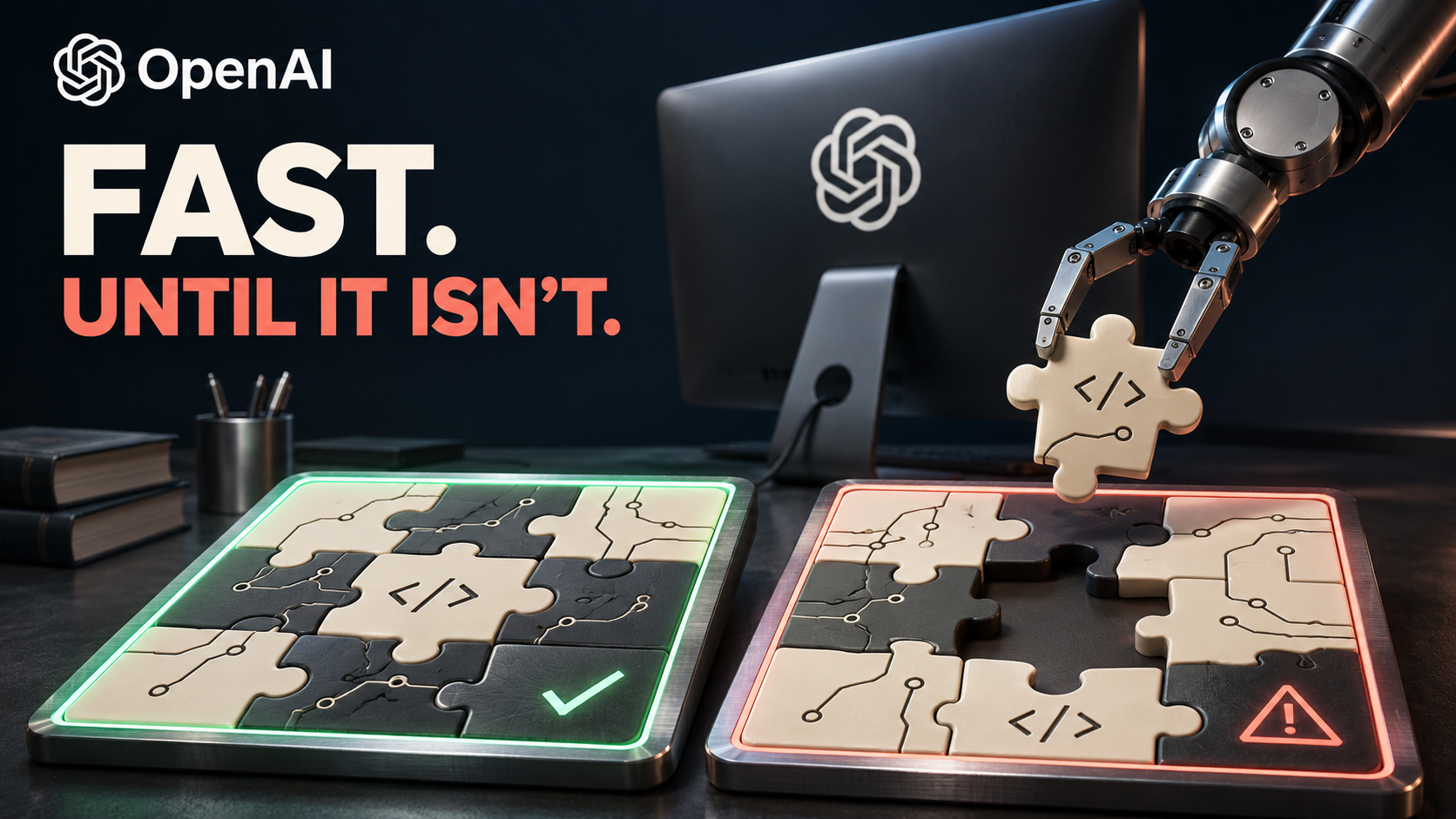

OpenAI says coding agents are increasingly accelerating its internal AI research and development, but its own measurements show the gain is uneven. Autonomous success is notably higher for monitoring training runs than for inference and serving code, according to the company. OpenAI calls this a "jagged frontier" rather than a steady advance across every kind of software task. That is a more useful disclosure than an aggregate capability claim, because it shows where the agents can be trusted and where they can't.
The distinction matters because broad claims about AI-assisted research blur two questions: whether an agent can contribute useful work, and whether it can finish work without close human involvement. OpenAI's account answers the first with a yes for some workflows. On the second, it says success remains task-dependent. An agent that can inspect telemetry, investigate a failed run or make bounded changes around training operations may still be unreliable when modifying the code that delivers model responses. Those are both engineering work, but they carry different operational contexts, failure modes and validation demands. New Runtime reads OpenAI's update the same way: more agent use in research, with human oversight still important because performance differs by task.
OpenAI connects the results to recursive self-improvement, where AI helps with the research and engineering used to build later AI. The evidence supports a partial version of that loop. If agents cut the time spent on selected research-engineering tasks, researchers can run more experiments, maintain more infrastructure or investigate more failures in the same period, and OpenAI says that is already happening internally. The same evidence bounds the claim. Because autonomous performance is uneven, the benefit depends on the task, the checks around the output and the cost of being wrong. The lower success rate on inference and serving code is the important number, because that is the code closest to models running in production.
What's missing is the measurement itself. Neither OpenAI nor New Runtime gives the share of internal research work performed by agents, a benchmark score, a comparison with competing coding systems or the economic impact of the acceleration, so the finding can't be sized. For engineering teams, the lesson is to evaluate agents against concrete work rather than the label "can code." The questions that matter are what the agent is changing, how its failures show up, and whether the result can be verified before it touches a larger system.