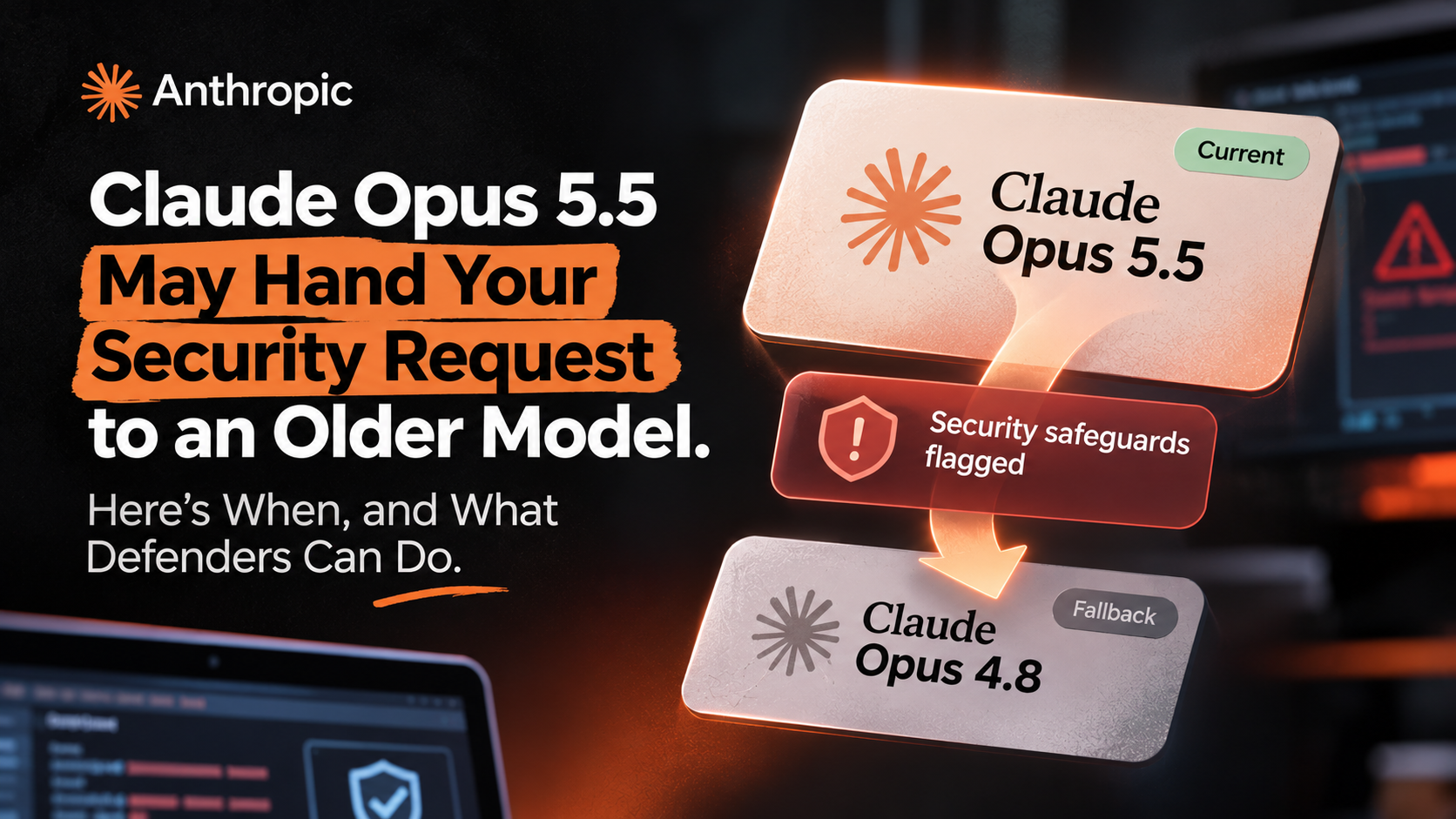

Anthropic says Claude Opus 5.5 can move a conversation to another model, or decline to continue, when its safeguards flag certain cybersecurity requests, including requests made for legitimate defensive purposes. That comes from Anthropic’s own help documentation, not from user reports.
How it works. Opus 5 and Opus 5.5 may fall back to Opus 4.8 when Anthropic’s cyber classifiers flag potentially higher-risk offensive cybersecurity requests, and the blocked request is re-run on the less capable model in the same conversation. If you switch back to Opus 5.5 after an automatic switch, the same safeguards may cause another fallback if the original request is still part of the conversation. Anthropic’s page, as described in your supplied material, names penetration testing, exploit generation, and binary scanning as categories that can trigger it. Anthropic explicitly says legitimate defensive use can be affected.
Why that’s awkward for defenders. Defensive work can require the same capabilities that raise safety concerns: inspecting a suspicious binary, reproducing an exploit to confirm a patch, or creating test material for an authorized penetration test. Anthropic doesn’t say Claude refuses all security work, only that a classifier can change which model answers during an investigation, when continuity and capability may matter.
For builders. Anthropic’s API guidance treats a refusal as an outcome developers should handle. When Opus 5.5 declines, it recommends retrying with a fallback model and names Opus 4.8 as an example. That leaves the application to detect the refusal, decide whether to reroute, carry enough context to the next model, and judge whether the fallback is good enough for the task. Anthropic doesn’t promise it will match Opus 5.5’s results or answer everything that triggered the refusal.
The verification catch. Anthropic says defenders with a legitimate purpose can apply to its Cyber Verification Program, but its help page also said Opus 5.5 wasn’t currently available in the program, and that organizations already using Opus 4.8 through it could access Opus 5 with fewer cyber restrictions. Anthropic expanded the program on October 6 into tiers and covered models, so the current coverage for Opus 5.5 is something to check directly. Anthropic’s published material also doesn’t state approval rates, processing times, full eligibility rules, or how often ordinary defensive tasks get switched or refused.
How common is it? Anthropic’s documentation reports that in early testing, Opus 5 traffic hit cyber fallbacks 85% less than Fable 5, as quoted by a third-party summary. That suggests the safeguards are narrower than on Anthropic’s most restricted model, but it doesn’t say how often defensive users are affected.
OpenAI’s comparison doesn’t settle it. OpenAI says GPT-6.1 Sol beats “Opus 5.5 with fallbacks” on its GDP.pdf professional-work evaluation, and classifies Sol as Critical for cybersecurity capability, the highest category in its framework, with its Astra safeguards applied. Those are OpenAI’s own results on its own test, so they don’t show how Sol or Opus 5.5 handle the same authorized security task.
Bottom line: Anthropic confirms Opus 5.5 access is conditional for some cyber-related work. The practical steps are to test the model on your authorized workflows, build for refusal and rerouting, and confirm whether verification covers Opus 5.5 before you rely on it. Nothing published shows how Sol compares in practice, so avoid treating either company’s approach as more permissive.