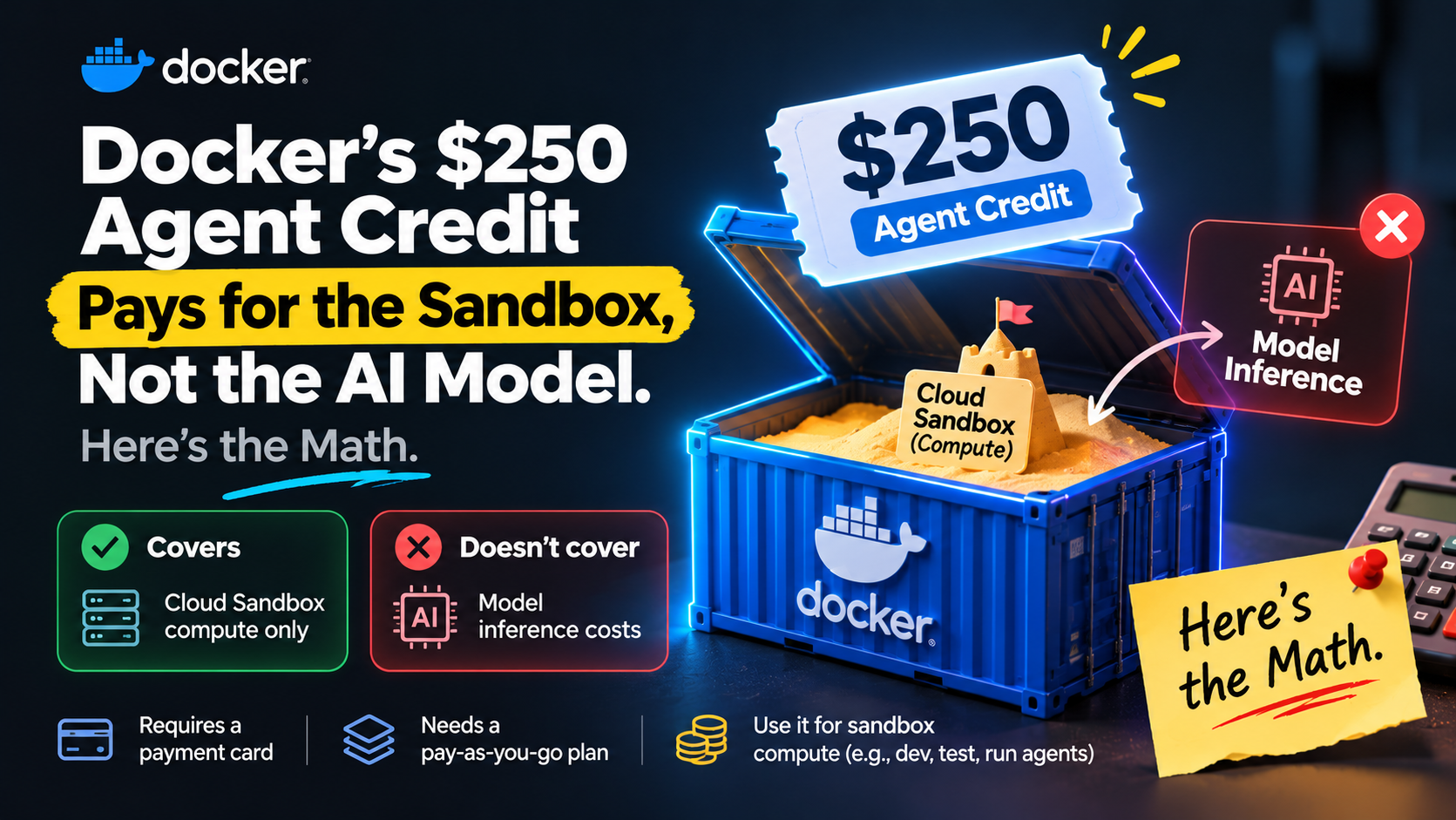

Docker’s $250 credit for new Docker Agentic Platform users covers cloud sandbox compute only, not the AI model an agent uses. The credit replaces the standard $25 and counts sandbox compute only, measured from start to stop. The model provider bills inference separately, which makes this an infrastructure credit and not an end-to-end agent budget.
What the credit covers. Sandboxes bill by the second, and setup, idle time, and retries all count against the credit. Docker’s listed rates run from $0.07 an hour for a Micro sandbox (1 vCPU, 2 GB) to $1.118 an hour for XL (16 vCPU, 32 GB), and Docker says $250 buys about 3,570 hours of Micro, 890 hours of Medium, or 225 hours of XL. The credit is non-transferable, has no cash value, and expires six months after you redeem it.
What it doesn’t cover. Users bring their own model or API key, so inference costs stay separate. Docker supports agents including Claude Code, Codex, Copilot, OpenCode, and Hermes. So an agent can run on Docker’s credit while generating charges from its model provider. A free sandbox doesn’t make an agent run free.
The conditions. The offer is for new signups, limited to one per user and account, and requires a valid card at signup, which is charged only for usage beyond the credit. It requires the pay-as-you-go plan, available on Docker Personal and Pro. The original terms ran through October 31, 2026, but Docker’s promo page now says the offer is valid through January 31, 2027.
Limits on “keeps working after you close your laptop.” Docker describes Cloud Sandboxes as isolated microVM environments on Docker-managed compute where an agent can keep working after you shut the lid. The docs say cloud sandboxes expire after one hour by default, and Docker’s announcement puts the ceiling at up to 24 hours per session. That fits many tasks but isn’t indefinite, so plan long jobs around it.
What isn’t published. The documents Docker has released don’t say when usage reports update, what happens in detail once the credit runs out beyond charging the card, or what a particular agent task costs in compute and tokens combined. Docker’s sandbox rates only estimate one of the two meters.
Bottom line: Docker’s offer is a generous way to try Cloud Sandboxes, with hundreds of hours of compute at the smaller sizes, but it only offsets the runtime. If you’re comparing agent platforms by cost, track the sandbox bill and the model provider’s bill separately, and check the live promo page for the current deadline.