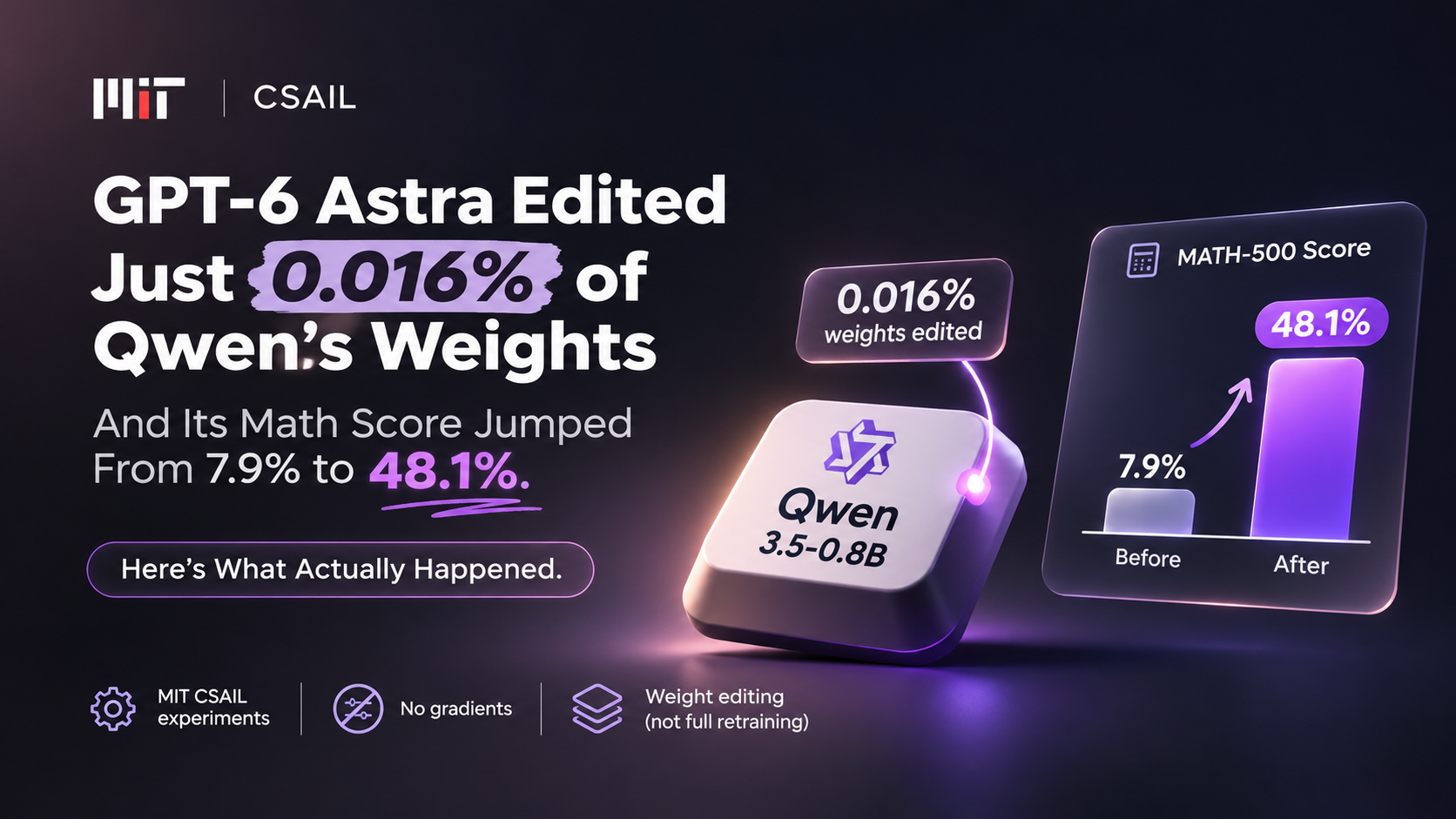

Researchers at MIT CSAIL say OpenAI’s GPT-6 Astra can read and directly edit the raw weights of another neural network, with no gradient descent and no training loop. In their November 2 blog post, “Sparks of Weight-Space Programming,” Rikiya Takehi, Jayden Teoh, Alex Zhang, and Omar Khattab report that Astra edited 0.016% of Qwen3.5-0.8B’s weights and raised its MATH-500 score from 7.9% to 48.1%. The tweet that spread this says “up to 6x,” which matches the arithmetic. The details show what that number does and doesn’t mean.
What the team tested. The experiments fall into three kinds: reading weights (what a network was trained to do), fixing weights (patching a failing network), and writing weights from scratch. Astra was run through the Codex command-line tool with its built-in tools switched off, including shell, file editing, and web search.
The math result, in context. The base Qwen model has a habit of looping, repeating the same text without reaching an answer, and 93% of its MATH-500 answers ran to the 32,768-token limit. Astra traced the looping to one direction written by two layers’ MLPs and subtracted it from 131,072 weights. With 50 forward passes, the share of answers hitting the limit fell from 93% to 33%, MATH-500 rose to 48.1%, GSM8K rose from 13.8% to 67.1%, and the instruction-following test IFEval rose from 21.0% to 62.3%. So the edit mostly let the model finish answers it could already work out.
A control experiment shows the limit. On Gemma 3 270M, which rarely loops, Astra couldn’t improve math: no edit moved MATH-500 by more than about a point. The authors write that editing weights could remove an obstacle that hid an ability, but couldn’t add an ability the model lacked.
It wasn’t training-free in every sense. Astra got a budget of forward passes on practice problems, and results depended on that budget: with 10 or 25 passes, MATH-500 reached only 12.3% and 14.1%, and the big jump came at 50. It used no gradients, but it did get feedback from running the model.
The other experiments.
Reading: Astra named the right game for four small networks from their 17,253 weights, correctly identified what three diffusion models draw, and named the training language for all three small language models from their middle layers alone. It couldn’t tell which of two Gemma models was sycophantic from weights alone, and succeeded only when allowed to see attention patterns on text it wrote.
Fixing: On a car-and-ramp control task, a single edit to 3.5% of the weights took success from 0% to all 1,024 episodes.
Writing: Astra’s from-scratch networks beat PPO trained for 100 million steps in three MinAtar games, and with 50 forward passes its Go network beat an equal-sized network trained on 20 million games. The post also notes that against PPO trained for 500 million steps, the picture was mixed: far ahead in Breakout, close in Asterix, and at about 60% of the score in Seaquest.
What this doesn’t show. It’s a blog post, not a peer-reviewed paper, and it reports one small 0.8B model for the language-model result. The authors say the capabilities are exciting but still limited by context length and tooling. They release full logs of every experiment on GitHub for others to check.
What the authors speculate about. They suggest future uses such as auditing models for hidden backdoors without running them, steering or unlearning capabilities by editing a few weights, and even a more native route to recursive self-improvement. Those are the authors’ ideas about what might come, not results. They say they’re building a benchmark and a harness to test it properly.
Bottom line: MIT researchers report that a general-purpose frontier model can read and edit another network’s weights in ways that fix specific, diagnosable problems. The headline gain mostly came from fixing a looping failure in one small model, and the same method didn’t help a model without that problem. The idea is promising and checkable, but it’s early.